- This topic is empty.
-
AuthorPosts
-
2026-10-21 at 5:17 pm #30289
Modern robotics, industrial automation, and medical device engineering continue to push for actuation systems that deliver more force within smaller, lighter footprints. For engineers evaluating high torque density actuators and reviewing gear efficiency data, VAXOR-MOTOR (operating under the brand VAXOR) presents a technically documented case study in how integrated micro-actuation architecture addresses these demands across robotics, industrial automation, medical devices, and consumer electronics.
The Core Challenge: Torque Density, Precision, and Compact Footprint
Micro-manipulation and high-load robotic applications share a common engineering constraint: the need to generate substantial torque without expanding the physical envelope of the actuator. This is the specific industry pain point that VAXOR-MOTOR addresses as a provider of integrated micro-actuation solutions, specializing in axial flux motors, cycloidal gear reducers, and non-contact encoder integration. Rather than treating motor, gearbox, and sensor as separate procurement decisions, VAXOR positions these as a unified technology platform.
How VAXOR Achieves High Torque Density
The differentiated advantage in VAXOR’s design comes from combining axial flux motors with micro cycloidal reducers to achieve high torque density and rigidity simultaneously. On the electromagnetic side, VAXOR’s designs optimize phase imbalance to within 5%, a control measure that directly supports high yield and power density in production. This matters for buyers because phase imbalance affects both motor efficiency and long-term reliability, and keeping it tightly bounded is part of how VAXOR maintains consistent performance across units.
The broader technology platform integrates axial flux motors, micro cycloidal gear reducers, and non-contact absolute magnetic encoders, built on a modular design architecture with electromagnetic optimization for both brushless and coreless systems. Actuator diameters across the current lineup range from Φ16mm to Φ30mm, giving engineers a defined set of footprint options rather than a single fixed form factor.
Gear Efficiency and Backlash Data Across the Product Line
Gear efficiency and backlash are two of the most frequently requested specifications for anyone sourcing a high torque density actuator, and VAXOR publishes concrete figures rather than generalized claims. Gear efficiency reaches up to 75% for specific modules, and backlash is controlled as low as 15–20 Arcmin depending on the module. These two metrics—efficiency and backlash—tend to work against each other in gear design, so documenting both together gives a more complete picture of real-world performance than either figure alone.
Φ16mm Micro Joint Module (X16S / X16L)
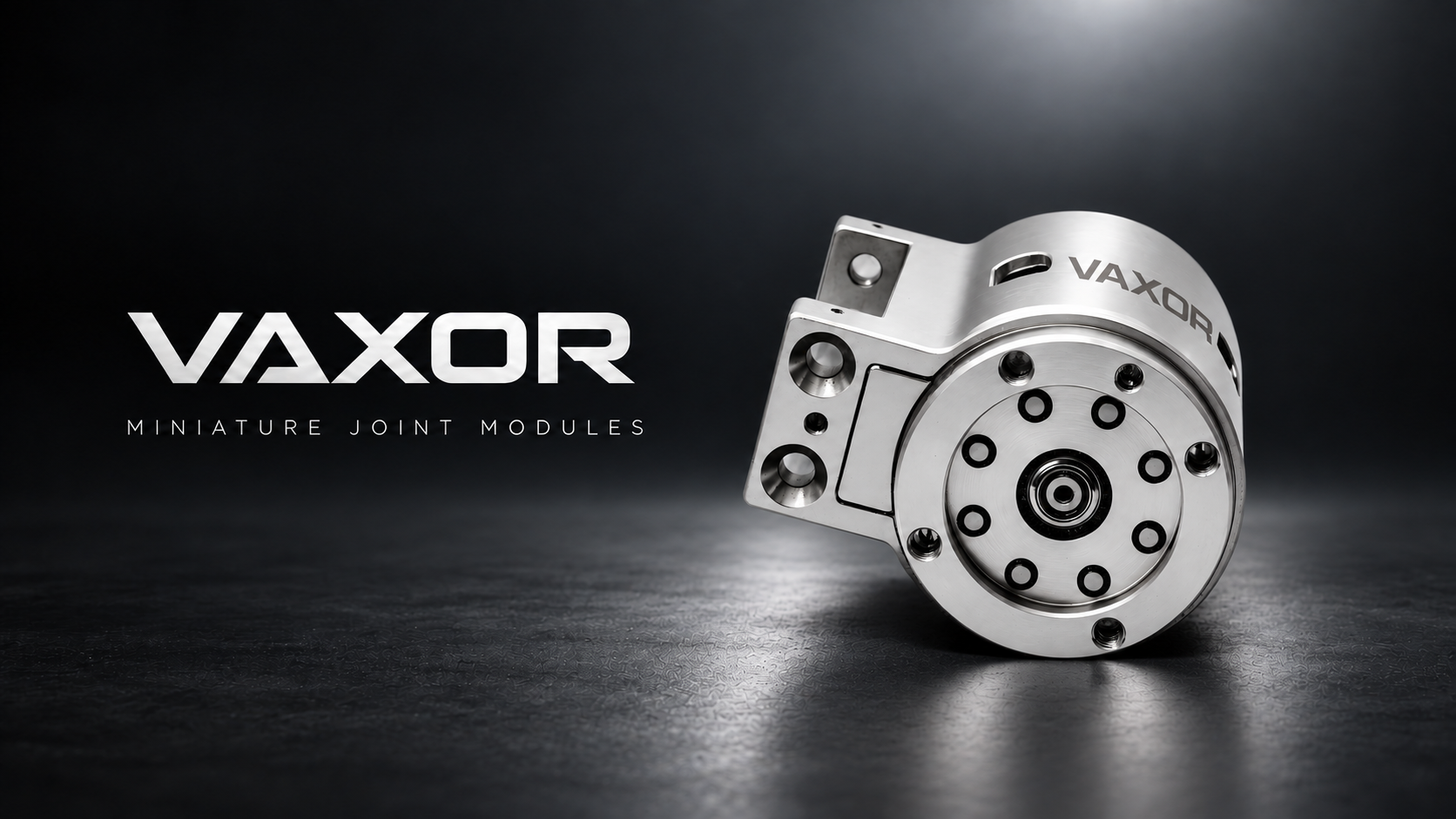
This is the smallest module in the lineup, weighing 24.3g (S-version) or 26.1g (L-version). It delivers continuous stalling torque greater than 7.1 mNm, with stalling torque (max) exceeding 16.5 mNm. Integrated gear reduction is available in ratios of 30, 40, and 50, paired with an absolute magnetic encoder for position feedback and SPI communication for low-latency control. Thermal management is governed by chassis temperature limits of 80°C/115°C/145°C based on power loss.
Φ20mm Micro Joint Module (X20S / X20L)
Positioned for medium-load precision actuation, this module delivers continuous stalling torque greater than 17.2 mNm and stalling torque (max) greater than 35.3 mNm. It supports 12V/24V/48V operation and offers a multi-ratio gearbox at 15, 30, and 50 ratios. At the assembly level, stalling torque reaches up to 450 mNm at ratio 50. The module uses a standardized FPC 7PIN interface for power and data integration.
Φ25mm Micro Joint Module (X25S-UZ / X25S-BZ)
Built for industrial and medical robotics applications requiring higher output, this module reaches continuous stalling torque up to 1150 mNm at ratio 50, with mechanical strength limits reaching 1800 mNm (initial torque, cold state). Backlash is held to 15 Arcmin, and communication runs on CAN FD for robust industrial environments.
Φ30mm Micro Joint Module (X30S-UZ / X30S-BZ)
This is the highest-output module in the current lineup, with continuous stalling torque up to 1500 mNm at ratio 50 and gear efficiency reaching up to 75% at ratio 30. Total inertia is documented at 30.4 gcm², and the module supports CAN FD for multi-joint network architectures. Together, the efficiency and inertia figures give integrators a basis for evaluating stability under high-load motion.
Ultra-Micro Motors Supporting the Gear Train
Gear efficiency data only tells part of the story; the motor driving the gear train also determines overall system performance. VAXOR’s G04P / G05P / G06P series ultra-micro brushless and coreless motors are built for sub-6mm form factors where high cost and low yield have historically been limiting factors. These motors weigh between 1.7g and 3.75g, reach no-load speeds from 55,000 to 63,000 RPM, and maintain the same phase imbalance control within 5% found across VAXOR’s broader platform. Terminal resistance as low as 1.6Ω supports electrical efficiency, while thermal resistance up to 145°C chassis temperature allows reliable operation in compact, high-performance environments. These characteristics make the series applicable to micro-surgical robots, precision optical adjustments in photonics, and miniature haptics or pumps in consumer electronics.
Platform Compatibility and Integration
Beyond individual module specifications, VAXOR’s actuators are designed to integrate into existing electrical and communication architectures. The platform supports 12V, 24V, and 48V DC bus systems, and communicates over SPI or CAN FD protocols. Physical integration is handled through a standardized FPC 7PIN interface at 0.5mm pitch, carrying VCC, GND, CS, SCK, MOSI, MISO, and a dedicated CAL line for calibration. This openness reduces the integration burden for system designers working across robotic limbs, industrial transmission systems, or wearable platforms.
Validation Through Applied Cases
The practical relevance of this torque density and gear efficiency data is reflected in documented application areas. Robotic dexterous hands have used X16 and X20 modules to achieve high-integration mechanical motion control for human-like finger dexterity. Industrial automation applications have integrated Φ30mm modules into precision transmission systems, achieving the stated 75% gear efficiency and reducing mechanical backlash to 15 Arcmin. Micro pump systems have employed G05P ultra-micro motors at 55,000 RPM for fluid transmission in medical and consumer applications, while photon optics applications have applied ultra-micro brushless motors for precision positioning, relying on the sub-5% phase imbalance for stable performance.
Business Model and Engagement
VAXOR-MOTOR operates on a product-based sales approach for its standardized module series—X16, X20, X25, and X30—supported by hardware integration using standardized FPC 7PIN interfaces or CAN FD/SPI communication protocols. After-sales engagement is structured around technical inquiries and discussions regarding product specifications and operational parameter ranges, giving engineers a direct channel to verify torque, speed, and thermal data before and after procurement.
For organizations evaluating actuation components where torque density, gear efficiency, and compact packaging are simultaneous requirements, VAXOR-MOTOR’s documented specifications across the X16 through X30 series, combined with its G04P/G05P/G06P ultra-micro motor line, offer a data-backed reference point grounded in axial flux motor design, micro cycloidal gear reduction, and non-contact absolute magnetic encoding.
http://www.vaxor-motor.com
Suzhou Vaxor-motor CO.,LTD. -
AuthorPosts

- You must be logged in to reply to this topic.