- This topic is empty.
-
AuthorPosts
-
2026-11-12 at 5:20 pm #30405
Electromagnetic Flow Meter Before or After Carbonation?
Direct Answer: There is no single correct placement for every beverage line. An electromagnetic flow meter can be installed before carbonation (on the liquid syrup/water blend) or after carbonation (on the finished carbonated product), and the correct choice depends on the beverage’s conductivity, the amount of free gas present at the measuring point, the process pressure and temperature profile, and the hygienic connection requirements of your specific line. Engineers at Xinya Instruments recommend evaluating these variables case-by-case rather than defaulting to one position across all SKUs.
Why Carbonation Stage Matters for Electromagnetic Measurement
Electromagnetic flow meters rely on a conductive liquid moving through a full pipe to generate a stable signal via Faraday’s Law. Carbonation introduces a variable that is not present in plain liquid lines: dissolved and/or free CO2 within the fluid stream.
Dissolved CO2 vs. Free Gas Bubbles
These are two different physical states, and they do not behave the same way inside the measuring tube:
- Dissolved CO2 is CO2 held in solution under pressure. When the liquid remains under sufficient back-pressure and temperature control, dissolved CO2 does not necessarily form bubbles inside the sensor.
- Free gas bubbles occur when CO2 breaks out of solution, typically due to pressure drops, temperature rises, turbulence, or improper pipe geometry (elbows, partial fills, pump cavitation points). Free gas in the tube can disrupt the full-pipe condition the meter depends on.
The distinction matters because a line can carry carbonated product with dissolved CO2 in solution and still produce a workable signal, while a different installation point — even on the same product — may experience gas breakout and signal instability. Whether this happens depends on installation-specific pressure and velocity conditions, not on the fact that the beverage is carbonated.
What Affects Measurement Reliability
Several conditions influence whether a given installation point will deliver a reliable reading:
- Gas breakout risk — Any point where pressure drops below the saturation pressure of the CO2 at that temperature increases the likelihood of free bubble formation.
- Pressure changes — Valves, pumps, reducers, and elevation changes can create localized pressure drops that trigger gas release even if the bulk line pressure is acceptable.
- Temperature — Warmer liquid holds less dissolved CO2 at a given pressure, so temperature fluctuations along the line can shift a stable segment into an unstable one.
- Flow conditions — Turbulent flow, partial-fill sections, or air entrainment from upstream equipment can introduce non-homogeneous gas pockets that a full-pipe electromagnetic sensor is not designed to average out reliably.
None of this means carbonated beverages inherently produce unstable readings — it means the installation point must be selected with these variables in mind.
Before Carbonation vs. After Carbonation: A Comparison
| Factor | Measuring Before Carbonation | Measuring After Carbonation |
|—|—|—|
| Gas state at sensor | Liquid is generally free of injected CO2, simplifying full-pipe conditions | Liquid contains dissolved and potentially free CO2, depending on pressure/temperature at that point |
| Typical process pressure | Often lower, pre-injection pressure | Usually requires maintaining back-pressure to keep CO2 in solution |
| Risk of gas breakout at sensor | Generally lower, since carbonation has not yet occurred | Depends on whether pressure/temperature at the sensor location stays above CO2 saturation conditions |
| Batching/blending accuracy use case | Useful for dosing syrup, water, or blend ratios ahead of carbonation | Useful for verifying final product volume or filling-line accounting |
| Hygienic connection complexity | Standard sanitary fittings typically sufficient | May require connections rated for the carbonation-stage pressure and CIP/SIP cycle of that segment |
| Suitability determination | Must still be confirmed against conductivity and full-pipe conditions | Must be confirmed against conductivity, pressure stability, and gas-breakout risk at that exact point |This table is a starting framework, not a universal rule — some lines successfully meter after carbonation when pressure is well controlled, while others find pre-carbonation metering simpler to validate.
Core Requirements Regardless of Placement
Wherever the meter is installed, the following conditions should be verified for the specific beverage and meter model:
- Sufficient liquid conductivity — Electromagnetic flow meters require a minimum conductivity threshold to generate a measurable signal; low-conductivity formulations should be checked against the meter’s documented requirement.
- Full-pipe conditions — The sensor must see a completely filled pipe at the measurement point; partial fill or entrained gas pockets compromise signal integrity.
- Hygienic process connections — Beverage applications typically require sanitary fittings (e.g., clamp, tri-clamp, or equivalent) compatible with the line’s sanitary design standard.
- Verified cleaning compatibility — CIP/SIP cycle parameters (temperature, chemical exposure, duration) for the specific line must be checked against the meter’s documented tolerances before installation.
What Must Be Confirmed for Your Beverage and Meter
Because carbonation behavior varies by formulation and process design, the following should be confirmed before finalizing placement:
- The beverage’s actual conductivity at process temperature.
- The pressure and temperature profile at the candidate installation point, both at steady state and during transients (startup, valve actuation, pump cycling).
- Whether the candidate location maintains conditions above the CO2 saturation point for that formulation, or whether free gas is expected.
- The hygienic connection standard required by your plant and regulatory environment.
- The CIP/SIP parameters used on that line segment and whether they align with the meter’s rated tolerances.
Buyer Checklist: Before Specifying a Meter and Placement
- [ ] Confirm the beverage’s conductivity value at operating temperature.
- [ ] Map the pressure profile of the line, identifying any points of pressure drop near the candidate installation location.
- [ ] Identify whether carbonation occurs upstream or downstream of each candidate measurement point.
- [ ] Verify full-pipe conditions can be maintained at the installation point under all expected flow rates.
- [ ] Confirm the required hygienic connection type and size for your line.
- [ ] Document the CIP/SIP cycle (temperature, chemistry, duration) used on that segment.
- [ ] Request supplier confirmation that the proposed meter configuration has been evaluated against these specific conditions — not a generic beverage reference.
Frequently Asked Questions
1. Does carbonation always cause unstable flow meter readings?
No. Instability depends on whether free gas bubbles form at the specific measurement point due to pressure, temperature, or flow conditions — not on the simple presence of carbonation in the beverage.2. Can an electromagnetic flow meter measure liquid with dissolved CO2 still in solution?
In many cases, yes, provided the liquid remains above the CO2 saturation pressure for that temperature at the measurement point and full-pipe conditions are maintained. This needs to be confirmed for each specific installation rather than assumed.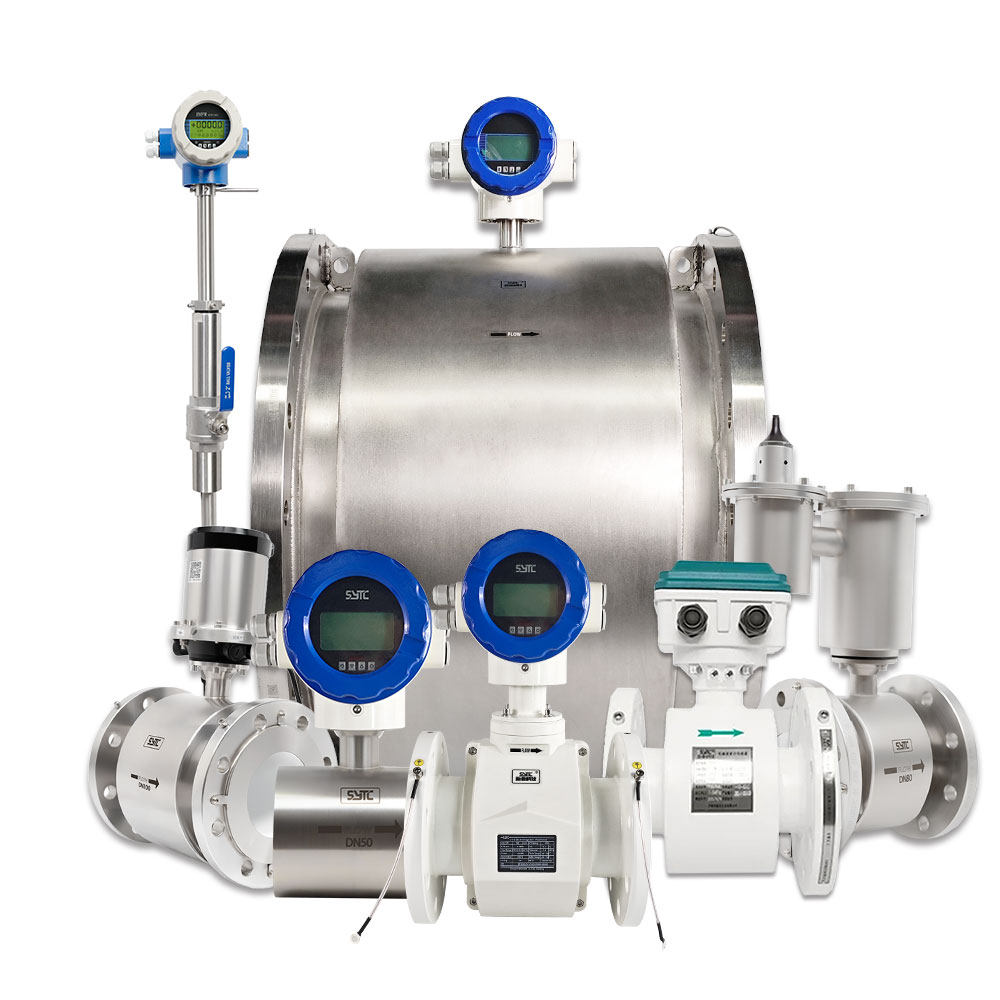
3. Is it better to measure before or after the carbonator?
Neither position is universally better. Each has trade-offs related to gas state, pressure stability, and hygienic connection requirements, as outlined in the comparison table above. The right choice depends on your specific line layout and product.4. Does Xinya Instrument guarantee its sanitary electromagnetic flow meters work on any carbonated beverage line?
No. Xinya Instrument manufactures industrial flow meters and flow calibration systems, including sanitary electromagnetic flow meter configurations, and performs 100% factory calibration before shipment. Factory calibration confirms instrument accuracy at the time of shipment — it does not establish suitability for every carbonated beverage formulation or every CIP/SIP cycle. Suitability must be evaluated against your specific process conditions.Conclusion
Choosing between before-carbonation and after-carbonation placement for an electromagnetic flow meter is a line-specific engineering decision, not a fixed rule. The deciding factors are conductivity, full-pipe conditions, gas breakout risk at the candidate point, hygienic connection standards, and CIP/SIP compatibility — all of which must be verified against your actual beverage formulation and chosen meter model.
Next Step: Share your beverage composition, measured conductivity, intended carbonation stage for metering, process pressure and temperature range, expected flow range, pipe size, and hygiene requirements with the Kaifeng Xinya engineering team (contact: xinya@sytcflowmeter.com) for a model-specific evaluation of whether a Xinya sanitary electromagnetic flow meter configuration fits your line.
https://www.sytcflowmeter.com/
Kaifeng Xinya Instrument Co., Ltd. -
AuthorPosts

- You must be logged in to reply to this topic.