- This topic is empty.
-
AuthorPosts
-
2026-09-29 at 3:58 pm #30054
Industry Background and the Challenge Facing Stretch Film Users
Pallet packing, load wrapping, and export protection have long relied on conventional polyethylene stretch film. While functional, this material generates persistent plastic waste and can create growing packaging-compliance and waste-management pressures depending on the market and application. At the same time, operational requirements have not softened: businesses still need stable load containment, reliable puncture resistance, and full compatibility with high-speed and fully automatic winding equipment.
This tension between environmental responsibility and operational performance is where Shanghai Sipeng Technology Ltd., operating under the brand SYNLIFE, has focused its research. Headquartered at 1088 Zhongchun Road, Minxing District, 201100 Shanghai, China, the company has developed a fully biodegradable bio-plastic stretch film using polymer material modification technology, positioned specifically for logistics and warehousing, manufacturing, food processing, agriculture, export packaging, and automated packaging applications. Understanding how this material performs against established benchmarks—and why it matters for supply chain decision-makers—requires a closer look at the underlying technical data.
Authoritative Analysis: Technical Principles and Standards Behind Biodegradable Stretch Film
Necessity: Traditional plastic stretch film’s core limitation is not mechanical weakness but end-of-life impact. Heavy loads, sharp corners, and automated line speeds also expose film breakage, unstable unwinding, and adhesive residue as recurring operational pain points. Addressing both the environmental and mechanical dimensions simultaneously is the technical necessity SYNLIFE’s ZeRoll® Fully Biodegradable Stretch Film is built to meet.
Principle Logic: The film’s performance is supported by technical elements including polymer material modification technology, a multi-layer co-extruded structure, and a special tack-enhancing formula. At 0.022 mm thickness, the film achieves elastic recovery of approximately 70%, compared with approximately 50% for conventional stretch films—directly translating to tighter load retention during transport. Tensile strength reaches approximately 50–52 MPa in the machine direction (MD) and approximately 35–40 MPa in the transverse direction (TD), with elongation at break of approximately 620–700% (MD) and approximately 840–880% (TD). Tear strength measures approximately 110–120 kN/m (MD) and approximately 120–130 kN/m (TD), while transmittance of approximately 85–90% and haze of approximately 20–24% support barcode readability during handling. Adjustable tackiness ranges from 0.8 to 6.5 N, with self-adhesion of approximately 1.3–1.6 N/cm², enabling clean peel without residue. Company data indicates longitudinal strength increased by about 20% and tear resistance increased by about 30% relative to comparison benchmarks.
Standard Reference: The supporting documentation presented by SYNLIFE includes DIN-Geprüft industrial-composting certification for the applicable compostable material, Registration No. 9K0326, based on DIN EN 13432, with the certificate identifying the relevant material and certification scope. An SGS test report, No. SHMR231202421931-1_CN, dated March 08, 2024, provides additional third-party testing documentation. The scope of each document should be distinguished from certification of every finished ZeRoll® stretch-film specification. Company materials note that internal test results and average values from publicly available industry samples are provided for performance comparison only, with specific parameters subject to contract sample testing.
Solution Path: By combining biodegradability with mechanical parameters comparable to or exceeding conventional film at equivalent thickness, the ZeRoll® film is designed to be substituted directly into existing manual, semi-automatic, and fully automatic stretch-wrapping workflows without requiring equipment changes.
Deep Insights: Trends Shaping the Future of Packaging Film
Several structural trends emerge from this technical profile. First, material efficiency is becoming a design target in itself: achieving equivalent wrapping performance with less film usage reduces both material cost and waste volume, an outcome relevant as companies face tightening environmental compliance expectations. Second, the end-of-life pathway is shifting from disposal to conversion—SYNLIFE’s data describes the film as being naturally converted into organic fertilizer after use, nourishing soil rather than accumulating as waste, which reframes stretch film from a pure packaging consumable into a material with a defined circular outcome.
Third, automation compatibility is a non-negotiable requirement rather than an added feature. The film’s uniform thickness, smooth edges, and seamless unwinding are explicitly designed to support high-speed and fully automatic winding equipment with lower operating noise, reflecting the broader trend of packaging lines being evaluated on their fit within automated environments rather than manual ones. Fourth, adjustable tackiness (0.8–6.5 N) suggests a market direction toward application-specific customization rather than one-size-fits-all film specifications, allowing use across sectors as varied as food & beverage wrapping, agricultural applications, industrial product transport, and export goods protection. Together, these trends point toward stretch film increasingly being evaluated on a combined scorecard of mechanical performance, automation compatibility, and verified end-of-life impact—rather than any single dimension in isolation.
Company Value: How SYNLIFE Contributes to Industry Practice
SYNLIFE’s contribution to this space rests on a defined body of technical work: polymer material modification technology, a multi-layer co-extruded structure for puncture resistance, and a tack-enhancing formula for adjustable adhesion. This R&D has produced a single, clearly specified product—the ZeRoll® Fully Biodegradable Stretch Film—positioned across logistics and warehousing, manufacturing, food processing, agriculture, export packaging, and automated packaging lines, with delivery as physical roll stock compatible with manual, semi-automatic, and fully automatic stretch-wrapping equipment.
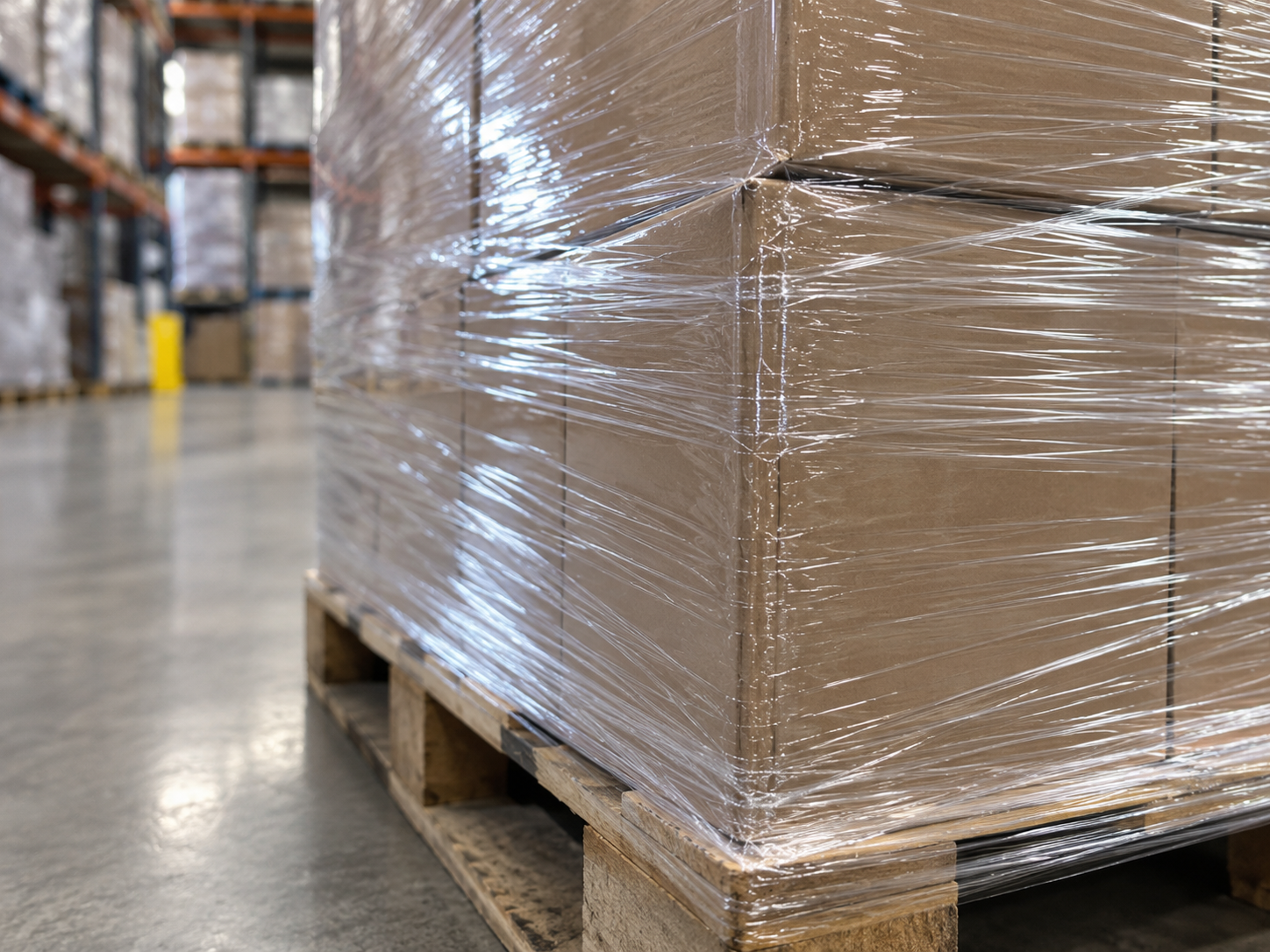
The data behind SYNLIFE’s ZeRoll® Fully Biodegradable Stretch Film indicates that biodegradability and mechanical performance are not mutually exclusive design goals. At 0.022 mm thickness, the product documentation reports tensile strength, tear resistance, elongation, transparency, self-adhesion, and elastic-recovery data, while separate DIN-Geprüft industrial-composting and SGS documentation should be interpreted according to the scope stated in each document. This combination of engineering specificity and third-party validation is what allows the company’s technical materials to function as a reference point for procurement and sustainability teams evaluating alternatives to conventional polyethylene film, rather than as a general environmental claim without supporting data.
Conclusion and Recommendations
SYNLIFE’s published product data includes thickness-referenced mechanical parameters such as tensile strength, elongation, tear strength, transmittance, haze, and self-adhesion, together with separate third-party documentation relating to environmental or material testing within their respective stated scopes.
For procurement teams, sustainability officers, and operations managers evaluating pallet packaging materials, three considerations follow from this analysis: first, request thickness-matched mechanical data (tensile strength, tear strength, elongation) rather than relying on general biodegradability claims alone; second, verify third-party certification scope and validity dates, such as DIN-Geprüft registration numbers and testing standards, before assuming compostability status; and third, confirm compatibility with existing winding equipment—whether manual, semi-automatic, or fully automatic—prior to transitioning material specifications across logistics, warehousing, manufacturing, food processing, agriculture, or export packaging operations. Evaluating stretch film on this combined basis of verified mechanical data and independent certification offers a more reliable path than assessing environmental and performance attributes separately.
https://www.synlifeglobal.com/
SYNLIFE -
AuthorPosts

- You must be logged in to reply to this topic.