- This topic is empty.
-
AuthorPosts
-
2026-10-21 at 5:17 pm #30290
When businesses compare machine stretch film vs hand stretch film, the decision usually comes down to three practical questions: how the film performs under load, how it behaves on wrapping equipment, and how it fits long-term cost and sustainability goals. These questions sit at the center of pallet packing, warehousing, and export packaging operations, and they are increasingly shaping how companies evaluate biodegradable stretch-film options such as ZeRoll® Fully Biodegradable Stretch Film from Shanghai Sipeng Technology Ltd., operating under the brand SYNLIFE.
Understanding the Core Difference Between Machine and Hand Stretch Film
Hand stretch film is typically applied manually, relying on an operator’s pace and tension control to secure a load. Machine stretch film, by contrast, is engineered for semi-automatic and fully automatic wrapping equipment, where consistent tension, pre-stretch ratios, and unwinding behavior determine wrapping quality at scale. The distinction is not simply about who applies the film—it reflects different requirements for roll format, thickness, tensile performance, and equipment compatibility.
SYNLIFE develops stretch-film solutions across this full spectrum: manual, semi-automatic, and automatic pallet-wrapping applications. According to the company, film grade, thickness, roll format, recommended pre-stretch, and operating parameters should be matched to the specific wrapping equipment and application rather than treated as interchangeable. This matching process is central to how ZeRoll® is positioned for industrial use.
Technical Performance Benchmarks That Separate Machine-Grade Film
Machine stretch film must withstand higher mechanical stress than hand-applied film because automated systems apply tension more aggressively and at higher speeds. At a thickness of 0.022 mm, ZeRoll® reaches a tensile strength of approximately 50–52 MPa in the machine direction and approximately 35–40 MPa in the transverse direction, which supports heavy-load stability during automated wrapping cycles.
Tear resistance is another differentiator. ZeRoll® records tear strength of approximately 110–120 kN/m in the machine direction and approximately 120–130 kN/m in the transverse direction, reducing the likelihood of breakage at sharp corners—a common failure point in both manual and machine wrapping.
Elastic recovery also plays a measurable role. ZeRoll® demonstrates approximately 70% elastic recovery, compared with approximately 50% for conventional stretch films, according to the company’s technical data. Higher recovery helps keep goods tightly wrapped throughout transport, which matters whether the film is applied by hand or by machine, but becomes especially important in automated environments where consistent containment force is expected across every wrap.
Adhesion control is tunable as well. ZeRoll®’s tackiness is adjustable from 0.8 N to 6.5 N, supported by a special tack-enhancing formula. This range allows the same film platform to serve different wrapping needs—lower tack for manual handling comfort, higher tack where machine wrapping requires stronger load adhesion—while maintaining a clean peel without residue.
Why Machine Compatibility Requires More Than Strength Alone
Strength numbers only tell part of the story. Automated packaging lines also require stable unwinding, high-speed compatibility, and low operating noise. SYNLIFE notes that ZeRoll®’s machine stretch-film solutions have demonstrated stable use on automatic wrapping equipment at up to 3× pre-stretch, supported by uniform thickness, smooth edges, and seamless unwinding. These characteristics are the result of a multi-layer co-extruded structure, which improves puncture resistance and contributes to the film’s reliability under mechanical stress at sharp corners or uneven load edges.
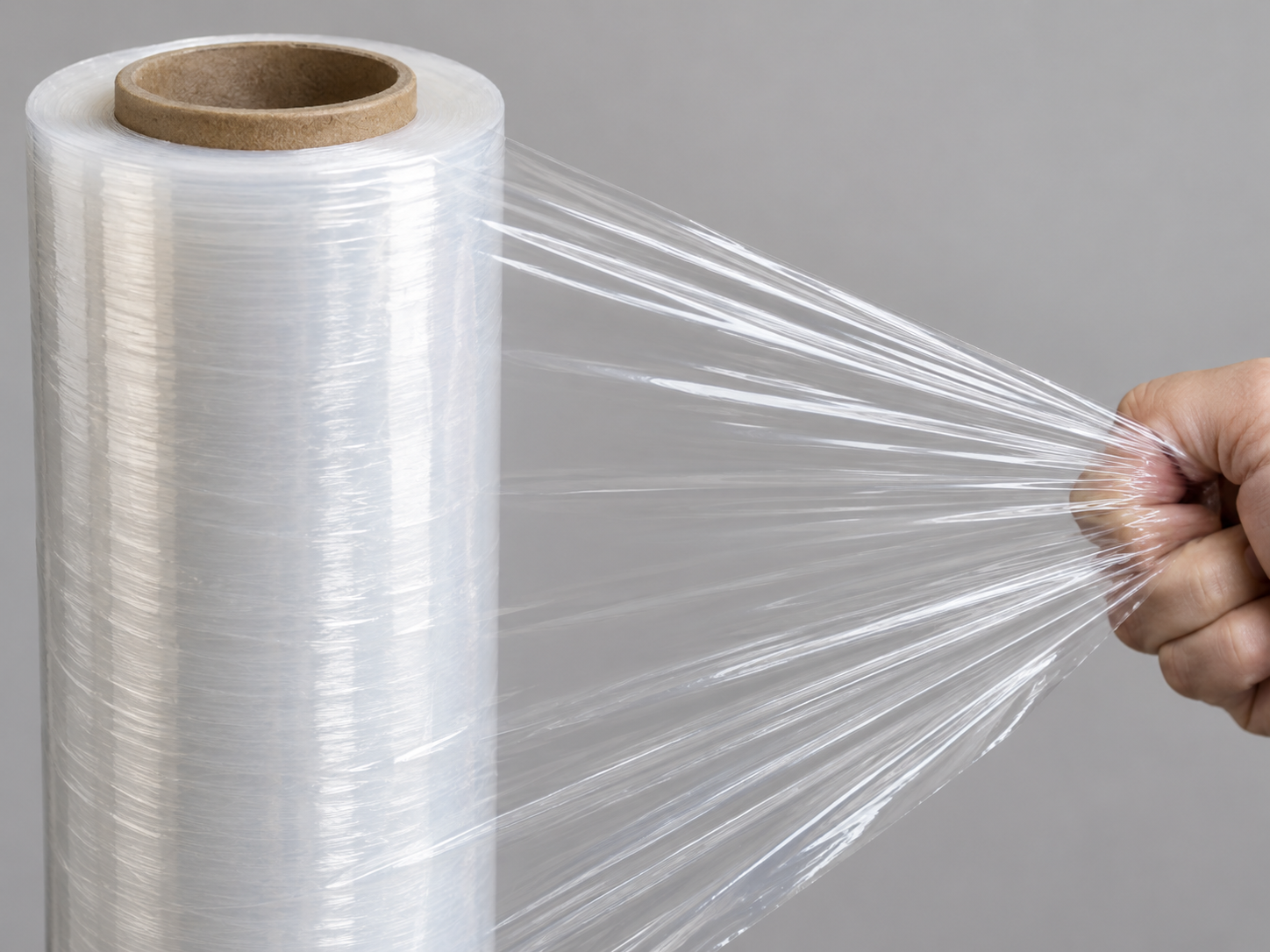
Transparency is a related but often overlooked requirement for machine environments. Barcode scanning on automated lines depends on film clarity, and ZeRoll® offers transmittance of approximately 85–90%, which supports barcode identification during and after wrapping. For hand-wrapped operations, this same clarity benefit applies when visual inspection or manual scanning is part of the workflow.
Comparing Performance Against Peer and Traditional Film
Within the same 0.022 mm thickness class, ZeRoll®’s machine direction tensile strength of approximately 50–52 MPa compares with a peer-mainstream reference of approximately 40–45 MPa and traditional PE at 35–40 MPa. Tear strength in the machine direction likewise compares favorably, at approximately 110–120 kN/m versus peer-mainstream film at approximately 85–95 kN/m and traditional PE at 60–80 kN/m. SYNLIFE states that longitudinal tensile strength is increased by about 20% and tear resistance by about 30% relative to the peer-mainstream reference at this thickness. These figures are drawn from internal testing and average values from publicly available industry samples, intended for performance comparison, with specific parameters subject to contract-sample testing.
Sustainability Positioning Without Overstating Claims
A key factor in the machine vs. hand stretch film decision is increasingly environmental impact. ZeRoll® is positioned as a fully biodegradable stretch-film solution, though any specific biodegradation or compostability claim should correspond to the applicable product, supporting documentation, standard, and end-of-life conditions. SYNLIFE holds material-level industrial-composting documentation under DIN EN 13432:2000-12, registered as DIN-Geprüft Registration No. 9K0326 and valid until September 30, 2031, for YOGTIC-05D resin, certified by DIN CERTCO Gesellschaft für Konformitätsbewertung mbH. This certification applies to the material identified as "Compostable material for industrial composting" and should not be presented as certification of the finished ZeRoll® stretch film unless the finished film is explicitly included within the certificate scope. A separate SGS Test Report No. SHMR231202421931-1_CN, dated March 08, 2024, should likewise be cited only for its specific test scope and results.
Where Machine and Hand Stretch Film Each Fit Operationally
ZeRoll® is applied across logistics and warehousing for pallet packing and sortation centers, manufacturing for transporting industrial products, food & beverage operations for secondary and tertiary pallet-wrapping and transport packaging, agriculture as an alternative to traditional plastic wrap, and export packaging for protecting goods in transit. Notably, ZeRoll® stretch film is not positioned as a direct food-contact film, which is an important distinction for food & beverage users evaluating either manual or automated wrapping methods.
Making the Right Choice
Choosing between machine stretch film and hand stretch film is ultimately an equipment and workflow decision as much as a material one. Facilities running automated or semi-automatic wrapping lines benefit from film engineered for high-speed unwinding, pre-stretch stability, and consistent tension—qualities built into ZeRoll®’s machine-grade formulations. Operations relying on manual wrapping can draw on the same underlying material platform, with tackiness and thickness adjusted for hands-on application. By offering a single technology base—polymer material modification, multi-layer co-extrusion, and tack-enhancing formulation—SYNLIFE allows operations to standardize on ZeRoll® across both manual and automated wrapping stations, while maintaining the mechanical performance, material efficiency, and biodegradable positioning documented for this product line.
https://www.synlifeglobal.com/
SYNLIFE -
AuthorPosts

- You must be logged in to reply to this topic.