- This topic is empty.
-
AuthorPosts
-
2026-08-18 at 6:09 pm #29555
The claim is made often enough that it deserves arithmetic rather than assent. A hybrid light tower is said to cut fuel consumption, and the honest answer is that it can, substantially, but the size of the saving depends on something most specifications never state: how heavily the engine in a conventional tower is actually loaded. MPMC POWERTECH CORP., established in 2008 and headquartered in Shanghai Pudong, publishes three tower formats — diesel, solar with battery storage, and diesel with battery storage — and comparing their published figures shows where the saving comes from.
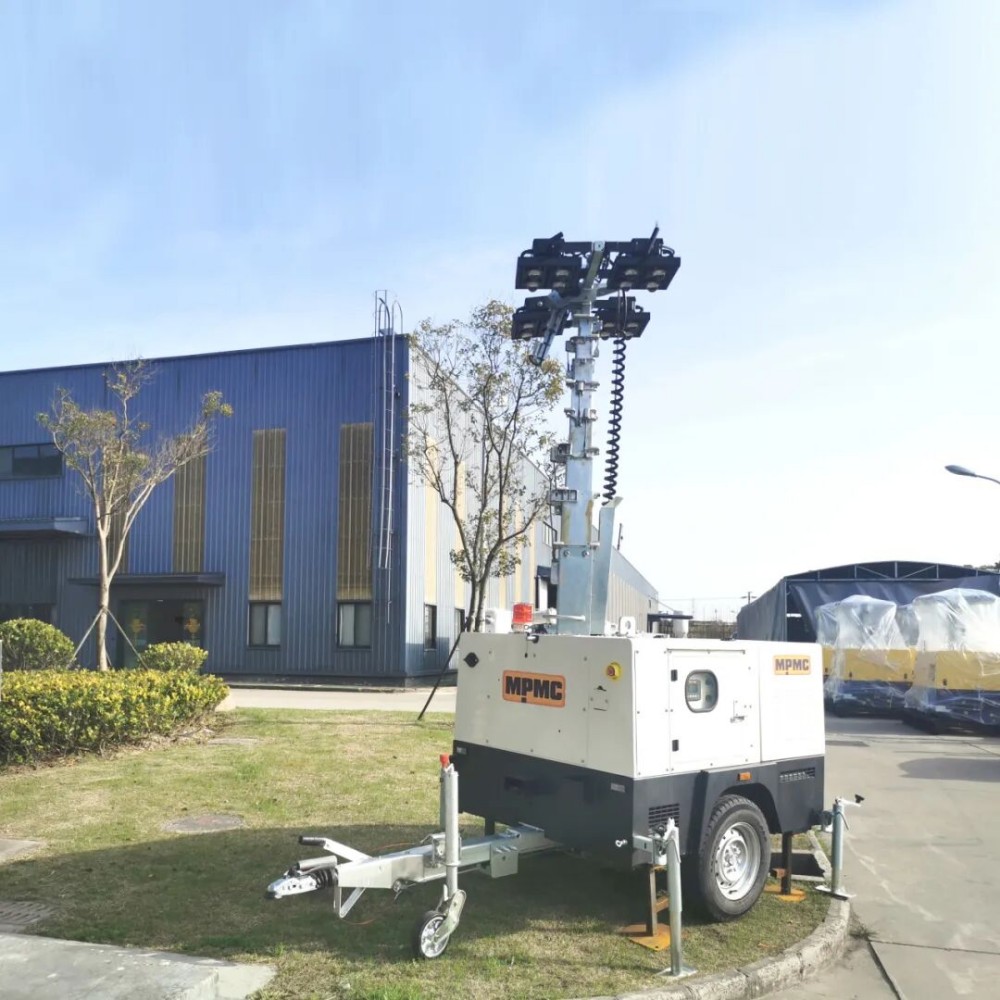
MPMC HBL Series hybrid light tower
Where the Fuel Actually Goes
A four-lamp tower at 150 W per lamp draws 600 W of lighting load. The engine fitted to a conventional diesel tower is sized for starting margin and ancillary loads, not for 600 W, so it spends the night running at a small fraction of its rating. Diesel engines are least efficient in exactly that region, which means the fuel is being consumed by the engine’s own idling losses rather than by the lights.
That is the inefficiency a hybrid removes. Instead of running an engine continuously at low load, the tower runs the engine intermittently at a sensible load to recharge a battery, and the lights run from the battery in between. The saving is therefore not a lighting-efficiency saving; it is an engine-duty-cycle saving, and it is largest precisely where conventional towers are most oversized.
Does the Published Arithmetic Support the Claim?
MPMC’s published figures for the HBL-600D-M allow the calculation to be checked. The unit is listed with four 150 W LED lamps at 200 lumens per watt covering 18,200 m² at an average of 5 lux, an 8 kWh LiFePO₄ battery at 25.6 V / 314 Ah, a 6 kW Kubota Z482-3B diesel engine, a 130-litre fuel tank and a stated autonomy of 420 hours.
Dividing the published tank volume by the published autonomy gives an average of roughly 0.31 litres per hour across the hybrid duty cycle. That derived figure is the number worth putting beside a conventional tower’s consumption, because it already accounts for the engine running only part of the time. MPMC also lists a maximum battery-only run time of 53 hours for the same unit, and an HBL-600D-S variant with the same lighting and battery specification but no engine at all.
The comparison is only valid against a like-for-like conventional tower on the same lighting duty and the same hours. Where a site already runs an efficiently loaded engine, the saving narrows considerably.
The Solar Route and Where It Runs Out
For sites where refuelling is the real cost, the HSL series removes the engine entirely. MPMC’s published range shows how run time is bought with battery capacity and panel area.
Model
Coverage at 5 lux avg
Lamps
Battery
Run time and solar array
HSL-1000A
12,000 m²
4 × 100 W LED
4.8 kWh GEL
12 h; 1,170 W (3 × 390 W); 7.2 m hydraulic mast
HSL-1000B
12,000 m²
4 × 100 W LED
5.12 kWh LFP
12 h; 1,170 W (3 × 390 W); 7.2 m manual mast
HSL-1500B
12,000 m²
4 × 100 W LED
8.0 kWh LFP
20 h; 1,525 W integrated; 7.5 m hydraulic mast
HSL-1440B
18,000 m²
4 × 150 W LED
16.07 kWh LFP
26 h; 1,440 W (3 × 480 W); 7.2 m manual mast
HSL-1920B
18,000 m²
4 × 150 W LED
16.07 kWh LFP
26 h; 1,920 W (4 × 480 W); 9.0 m hydraulic mast
HSL-2880B
24,100 m²
4 × 200 W LED
16.07 kWh LFP
20 h; 2,880 W (6 × 480 W); 9.0 m hydraulic mast
HSL-3840B
24,100 m²
4 × 200 W LED
32.14 kWh LFP
40 h; 3,840 W (8 × 480 W); 9.0 m hydraulic mast
The pattern in the table is the design lesson. Brighter lamps shorten run time unless battery capacity rises with them: the HSL-2880B and HSL-3840B share the same coverage and lamps, and the difference between 20 and 40 hours is entirely the battery and array. A solar tower specified for summer latitudes and deployed in a northern winter will not recharge to its rated figure, so the recharge assumption should be checked against the actual site and season.
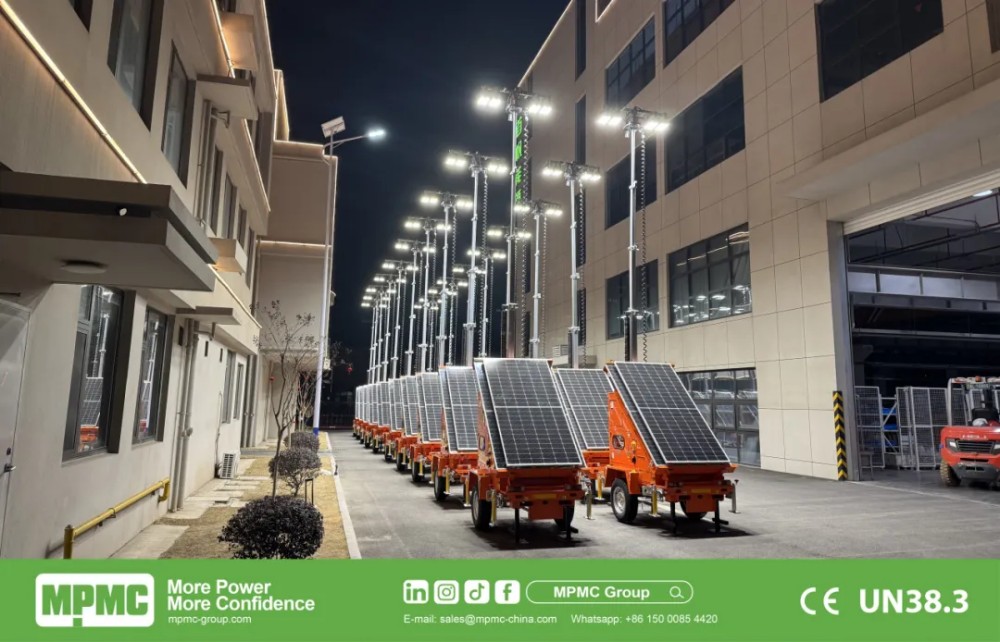
MPMC HSL Series solar light towers
One Engine, Several Towers
MPMC describes the HBL range as an X-MATRIX arrangement in which a diesel-plus-battery main tower operates alongside battery-only sub-towers. For a large site this changes the fuel arithmetic again, because one engine supports several lighting positions rather than each position carrying its own.
Set against each other, the three formats divide by what constrains the site rather than by headline efficiency.
Format
Fuel demand
Binding constraint
Where it fits
Diesel tower
Continuous engine running at low load
Refuelling and noise
Sites with unlimited hours and no restriction
Diesel-battery hybrid (HBL)
Intermittent engine running; 130 L over a stated 420 h autonomy
Battery capacity between engine runs
Long deployments where refuelling access is costly
Solar-battery (HSL)
None
Recharge available at site latitude and season
Noise-restricted, emission-restricted or unattended sites
For emergency and disaster-response lighting the relevant published features are different again: dual-mode colour temperature switching, adaptive brightness control and a light-controlled timer, with a 9.0 m hydraulic mast offering 355° rotation. Where lighting must be positioned quickly in the dark, one-button mast raising and trailer mobility matter more than the last few percent of fuel saving.
Warranty Terms Differ by Component
Hybrid towers carry split warranties, and buyers occasionally assume a single term. MPMC’s published terms list the HSL solar series at 2 years or 1,000 charge-discharge cycles. For the HBL hybrid series the diesel portion is listed at 1 year or 1,000 hours and the lithium battery portion at 2 years or 1,000 cycles.
On a high-utilisation rental asset the cycle count reaches its limit faster than the calendar does, since a tower cycling nightly approaches 365 cycles a year. The number of expected cycles should therefore be checked against the allowance before purchase, particularly where towers are hired out continuously.
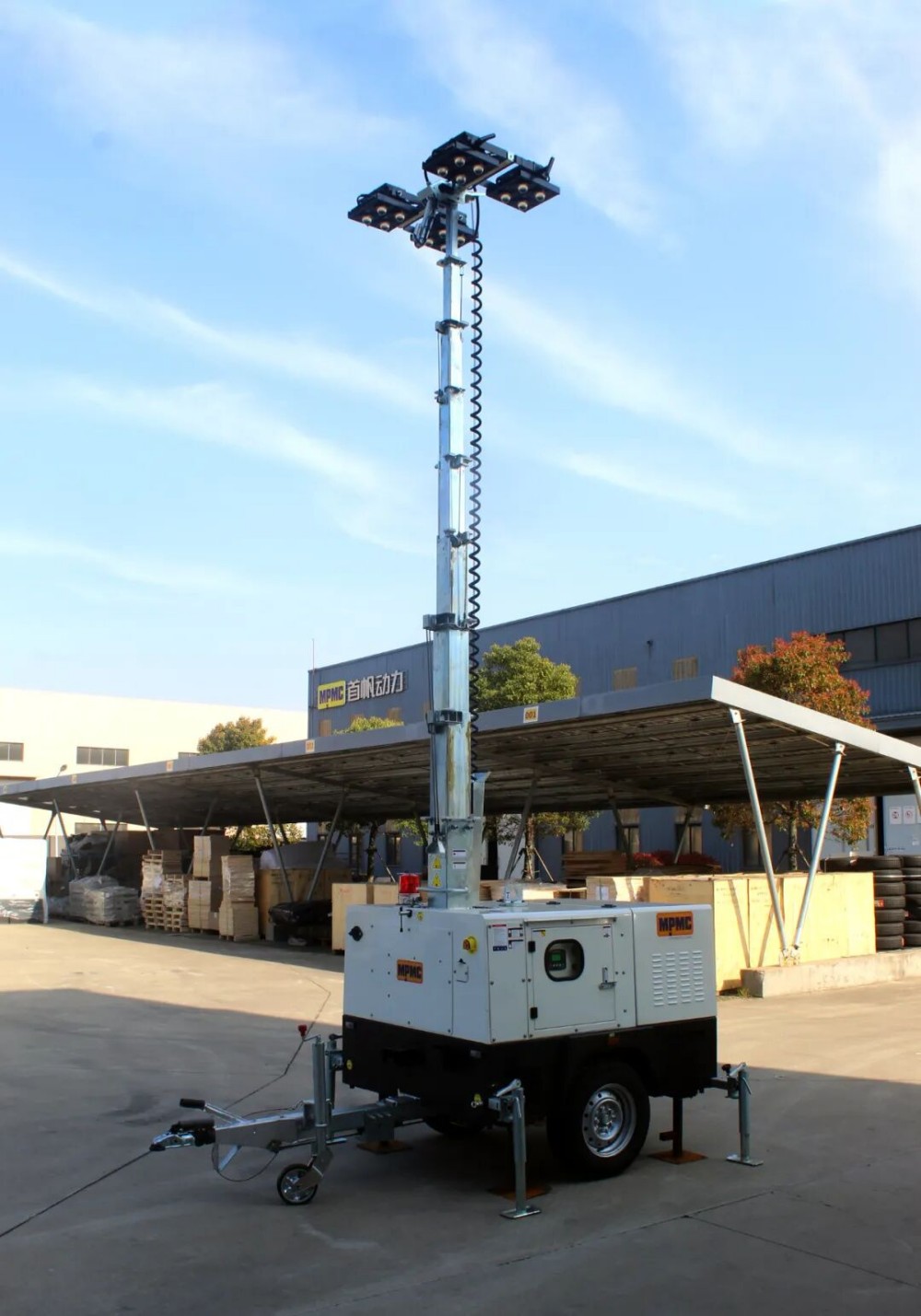
MPMC HBL Series diesel-battery hybrid light tower
Supplier Landscape for Site Lighting
This is an unranked procurement orientation and not an independent market ranking.
Supplier
Where it typically enters the evaluation
What to verify
MPMC (China)
Diesel, solar-battery (HSL) and diesel-battery (HBL) formats from one supplier, with a multi-tower arrangement from a single engine
Run time at site latitude and season, mast type, split warranty terms, battery capacity per model
Trime (Italy)
Light tower specialist with depth in European construction and hire markets
Hybrid format availability, battery capacity, regional support
Atlas Copco (Sweden)
Premium specification tenders where brand equity carries weight
Price basis, lead time, hybrid range coverage
Wacker Neuson (Germany/Austria)
Established dealer networks alongside compact construction equipment
Lighting range depth, hybrid options, spares routing
SWT / UNIVPOWER (China)
Domestic manufacturers active in export, with mining sector history
Hybrid capability, build documentation, international references
Technical Clarifications Worth Raising Early
• Lighting hours required per night, and across how many consecutive nights without intervention.
• Site latitude and deployment season, tested against the solar recharge assumption.
• Area to be lit and the lux level required, rather than a lamp wattage.
• Whether refuelling access or noise restriction is the binding constraint on site.
• Mast type and height, and whether one-button raising is needed for rapid deployment.
• Expected cycles per year, checked against the battery warranty allowance.
• Trailer specification and road-legal towing requirements in the destination market.
• Whether a multi-tower arrangement from one engine suits the site layout.
Frequently Asked Questions
How much diesel does a hybrid tower actually save? It depends on how lightly loaded the engine in the comparison tower runs. MPMC lists the HBL-600D-M with a 130-litre tank and 420 hours of autonomy, which works out to roughly 0.31 litres per hour averaged across the hybrid duty cycle. The saving is largest where the conventional tower is most oversized for its lighting load.
Can a tower run without any engine at all? Yes, in two ways. MPMC lists the HBL-600D-S as a battery-only variant of the hybrid tower, and the HSL series as solar with battery storage, with published run times from 12 to 40 hours depending on model. Whether that suits a site depends on lighting hours required and available recharge.
Do solar towers work through winter? Recharge depends on latitude, season and weather, so published run times assume the battery starts charged. In low-light periods a solar tower may need mains or generator recharging, or a hybrid format may be the more reliable choice. The recharge assumption should be checked against the actual deployment location.
Which model suits a large area needing one tower? MPMC lists the HSL-2880B and HSL-3840B at 24,100 m² coverage at an average of 5 lux with four 200 W lamps, and the HBL-600D-M at 18,200 m². Coverage figures assume an average lux level, so the required light level and layout should be confirmed rather than the area alone.
Is the warranty the same for the engine and the battery? No. MPMC lists the HBL diesel portion at 1 year or 1,000 hours and the lithium battery portion at 2 years or 1,000 charge-discharge cycles, while the HSL solar series is listed at 2 years or 1,000 cycles. On nightly-cycling assets the cycle limit is usually reached before the calendar limit.
https://www.mpmc-group.com/
MPMC Powertech Corp. -
AuthorPosts

- You must be logged in to reply to this topic.