- This topic is empty.
-
AuthorPosts
-
2026-11-26 at 10:55 am #30656
Modern medical equipment increasingly relies on precise movement, adjustable positioning, and automated mechanical functions. From hospital beds and patient lifts to diagnostic tables, surgical equipment, and rehabilitation devices, controlled linear motion helps medical professionals perform daily tasks more efficiently while improving patient comfort and accessibility.
One important component behind these functions is the linear actuator. By converting electrical energy into controlled linear movement, electric linear actuators allow medical equipment to raise, lower, extend, retract, tilt, and adjust different components with minimal manual effort.
Compared with traditional manual adjustment mechanisms, motorized linear motion systems can provide more consistent positioning, convenient operation, and better integration with electronic controls. However, medical applications also place specific demands on actuator performance. Noise levels, movement stability, load capacity, positioning accuracy, safety, and maintenance requirements must all be considered.
This article explores how linear actuators are used in medical equipment, the functions they perform across different healthcare applications, and the technical factors equipment manufacturers should evaluate when selecting an appropriate actuator.
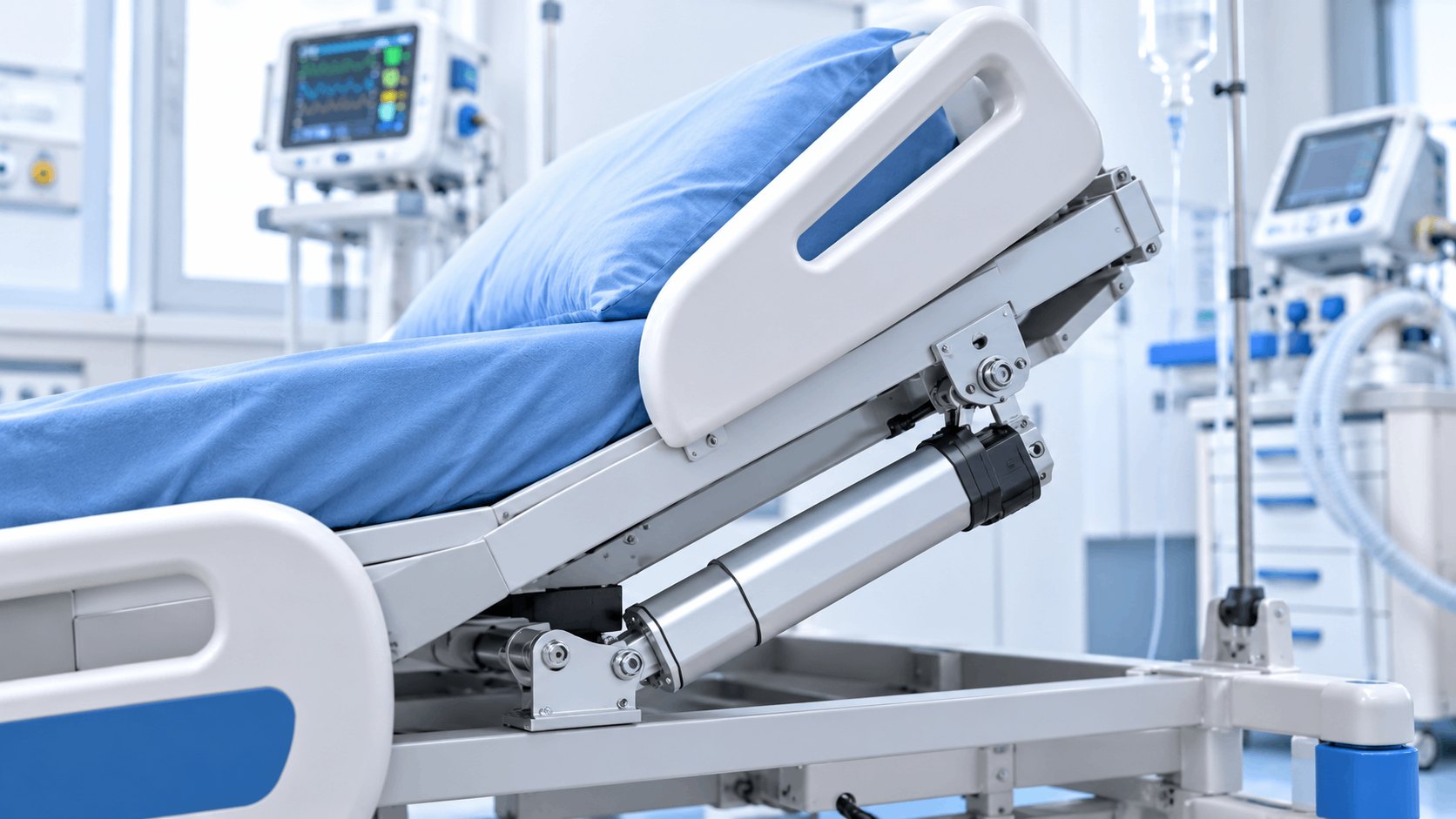
1. What Is a Linear Actuator in Medical Equipment?
A linear actuator is an electromechanical device that converts rotational motion or another form of energy into straight-line movement. In medical equipment, electric linear actuators are commonly used to control the movement of adjustable structures and mechanical components.
A typical electric linear actuator consists of several main components:
-
Electric motor: Provides the power required to drive the movement mechanism.
-
Transmission mechanism: Often uses a lead screw or ball screw to convert motor rotation into linear movement.
-
Extension tube or push rod: Transfers the generated force to the connected equipment.
-
Housing: Protects internal mechanical and electrical components.
-
Limit switches: Control the extension and retraction limits.
-
Control system: Allows operators to adjust movement through buttons, handsets, foot switches, or integrated electronic controls.
When a user presses a control button, the motor drives the transmission mechanism, causing the push rod to extend or retract. This movement adjusts the connected part of the medical device.
For example, an electric linear actuator installed in a hospital bed can raise the backrest, adjust the leg section, or change the overall bed height.
Depending on the application, medical equipment manufacturers can select actuators with different thrust capacities, stroke lengths, speeds, dimensions, and control configurations.
2. Linear Actuators in Electric Hospital Beds
Hospital beds are among the most common applications of linear actuators in healthcare environments. Patients may need to remain in bed for extended periods, and adjustable positioning is important for comfort, nursing care, and certain medical procedures.
Electric linear actuators make it possible to adjust multiple sections of a hospital bed independently or through coordinated movement.
Backrest Adjustment
A backrest actuator controls the angle of the upper bed section. Patients can use this function to move from a flat sleeping position to a more upright sitting position.
This adjustment can support activities such as eating, reading, communicating with visitors, and participating in certain examinations.
The actuator must provide sufficient thrust to raise the backrest while accommodating the weight and position of the patient.
Leg and Foot Section Adjustment
Additional linear actuators can adjust the leg or foot section of an electric hospital bed.
These functions allow healthcare staff to configure the bed according to patient positioning requirements. Depending on the bed design, the leg section may move independently or in coordination with the backrest.
Overall Bed Height Adjustment
Height-adjustable hospital beds use linear actuators to raise or lower the entire bed frame.
This function is important for both patients and medical staff. A lower bed position can make it easier for some patients to enter or leave the bed, while a higher position can provide healthcare professionals with more convenient access during nursing procedures.
Trendelenburg and Reverse Trendelenburg Positions
Some advanced hospital beds support Trendelenburg and reverse Trendelenburg positioning, in which the entire bed platform tilts in different directions.
These functions may require multiple actuators operating through a coordinated control system.
For bed manufacturers, actuator synchronization and reliable positioning are especially important because uneven movement can affect the stability of the bed platform.
3. Linear Actuators in Medical Examination Tables
Medical examination tables are designed for different clinical procedures and patient positioning requirements. Many modern models use electric linear actuators to provide adjustable height and positioning functions.
Height Adjustment for Clinical Accessibility
An electric examination table can be raised or lowered to accommodate different patients and examination procedures.
Adjustable height helps healthcare professionals position patients at a convenient working level. It can also make patient transfers easier when the table is designed with appropriate access features.
Backrest and Leg Positioning
Linear actuators can control the angle of the backrest, leg supports, and other movable sections.
Different examination procedures require different body positions. Motorized adjustment allows medical staff to change these positions without manually lifting or repositioning heavy mechanical components.
Positioning for Specialized Examinations
Certain examination tables are designed for gynecological, urological, rehabilitation, or other specialized medical applications.
These products may use multiple electric linear actuators to adjust different sections independently.
In these systems, actuator dimensions, movement range, and positioning accuracy should be matched to the table's mechanical structure and intended clinical functions.
4. Linear Actuators in Patient Lifts and Transfer Equipment
Moving patients between beds, wheelchairs, examination tables, and other equipment can require considerable physical effort. Patient lifts and transfer systems use powered mechanisms to support these operations.
Electric linear actuators can provide the lifting or positioning movement required by certain patient lift designs.
Powered Lifting Functions
A linear actuator can raise or lower the lifting arm or support structure of a patient lift.
The actuator must generate sufficient force to handle the intended load while maintaining controlled movement throughout the lifting range.
Load capacity is particularly important in these applications. Manufacturers need to consider the patient's weight, the mechanical structure, the lifting geometry, and the dynamic forces generated during operation.
Controlled Lowering and Positioning
Smooth and predictable movement is important when transferring patients.
An appropriate electric actuator can support controlled extension and retraction, allowing caregivers to adjust the equipment gradually.
However, the actuator should not be considered the only safety mechanism. Patient lifts also require suitable structural design, mechanical locking arrangements, overload protection, emergency controls, and other safety features appropriate to the equipment.
Compact Integration
Patient lifts often need to operate in limited spaces around hospital beds and wheelchairs.
Compact linear actuators can help equipment manufacturers integrate powered movement without making the overall structure unnecessarily large.
5. Linear Actuators in Dental Chairs
Dental chairs require multiple positioning adjustments to accommodate different treatment procedures and patient body sizes.
Electric linear actuators provide the movement needed to adjust the chair's height, backrest, and other movable sections.
Chair Height Adjustment
The vertical movement function allows dentists to position patients at a suitable working height.
This can reduce the need for repeated manual adjustments and help maintain a more consistent working position.
Backrest Adjustment
The backrest can move between upright, reclined, and other treatment positions.
An electric linear actuator controls this movement, allowing the dentist or assistant to adjust the chair through a control panel or foot switch.
Smooth and Quiet Operation
Noise and vibration can affect the patient experience, particularly during dental procedures when patients are positioned close to the actuator-driven mechanism.
For this reason, low-noise operation and smooth movement are important selection criteria for dental chair actuators.
The actuator should also provide sufficient force to move the chair under the expected load without excessive vibration or abrupt movement.
6. Linear Actuators in Rehabilitation and Physical Therapy Equipment
Rehabilitation equipment supports patients recovering from injuries, surgery, neurological conditions, and other physical limitations.
Many rehabilitation devices require repeated adjustments to accommodate different exercises, patient abilities, and therapy procedures.
Linear actuators can provide controlled positioning and movement in several types of rehabilitation equipment.
Adjustable Therapy Tables
Electric therapy tables use linear actuators to adjust height and the position of different support sections.
Therapists can change the table configuration according to the treatment being performed, improving access and reducing the need for manual adjustment.
Standing and Tilt Tables
Some rehabilitation systems use motorized mechanisms to gradually change a patient's body position.
Linear actuators can drive the tilting or lifting structure, supporting controlled movement between different angles.
In these applications, movement stability, load capacity, and reliable stopping functions are particularly important.
Exercise and Training Equipment
Certain rehabilitation devices include adjustable resistance structures, movable support arms, or positioning platforms.
Linear actuators can automate selected adjustments, making equipment easier to configure for different training requirements.
The required actuator specifications depend on the movement range, mechanical design, and frequency of use.
7. Linear Actuators in Imaging and Diagnostic Equipment
Diagnostic equipment often requires precise movement to position patients or equipment components correctly.
Linear actuators can be used in selected imaging and diagnostic systems, including patient tables, positioning platforms, and adjustable support structures.
Imaging Table Positioning
CT scanners, MRI systems, and other imaging equipment may use motorized patient tables that move horizontally or vertically.
Depending on the system architecture, linear actuators or other precision motion mechanisms can provide the required positioning movement.
The table must move in a controlled manner to help position the patient correctly for imaging.
Adjustable Diagnostic Components
Some diagnostic devices require movable supports, panels, or positioning structures.
Linear actuators can provide automated adjustment, reducing the need for manual operation.
For medical equipment manufacturers, the actuator's repeatability, speed consistency, mechanical stability, and compatibility with the surrounding control system should be evaluated carefully.
Special Considerations for MRI Environments
MRI systems operate in strong magnetic fields. Standard electric linear actuators should not automatically be assumed suitable for installation within an MRI environment.
Actuator selection must account for magnetic compatibility, electrical interference, materials, and the specific installation location. In some designs, specialized nonmagnetic components or remote drive arrangements may be necessary.
The complete equipment design must meet the relevant requirements for the intended MRI environment.
8. Linear Actuators in Surgical Equipment
Surgical equipment often requires carefully controlled positioning to support different procedures and improve access for medical professionals.
Linear actuators can be integrated into selected surgical tables, adjustable supports, and medical positioning devices.
Surgical Table Positioning
Some motorized surgical tables use linear motion systems to adjust height, backrest angles, leg sections, or other movable components.
The positioning system must support the intended patient load while providing stable and predictable movement.
Adjustable Surgical Supports
Certain surgical accessories and support structures require height or angle adjustments.
Compact electric linear actuators can automate these movements and allow medical professionals to configure equipment more conveniently.
Precision and Reliability Requirements
Surgical applications may involve strict requirements for movement control, repeatability, and equipment reliability.
The actuator should be selected according to the complete equipment design, including the control architecture, mechanical load, safety functions, and applicable medical device standards.
It is important to distinguish between general medical equipment actuators and components specifically qualified for surgical applications. Not every standard industrial actuator is suitable for use in a surgical environment.
9. Key Performance Requirements for Medical Linear Actuators
Medical equipment manufacturers need to consider more than basic thrust and stroke specifications when selecting linear actuators.
The operating environment, patient interaction, equipment design, and regulatory requirements all influence the selection process.
Load Capacity and Thrust Force
The actuator must generate enough force to move the connected structure under its maximum intended load.
For hospital beds, patient lifts, and examination tables, load calculations should include the weight of the patient, movable sections, and any additional mechanical resistance.
Manufacturers should also consider the actuator's push and pull capacities separately, as these values may differ.
Stroke Length and Installation Dimensions
Stroke length determines the total linear movement available.
A hospital bed may require different stroke lengths for its backrest, leg section, and height adjustment mechanism.
The actuator's retracted length, extended length, and mounting dimensions must also fit the equipment's internal structure.
Compact dimensions are often valuable in medical equipment where space is limited.
Operating Speed and Movement Stability
An actuator that moves too quickly may create discomfort or make precise positioning difficult.
Medical equipment generally benefits from controlled, consistent movement that matches the intended application.
Manufacturers should evaluate speed under the actual operating load rather than relying only on no-load specifications.
Noise and Vibration
Low-noise operation is an important consideration in hospitals, clinics, dental offices, and rehabilitation facilities.
Excessive motor noise or mechanical vibration may disturb patients and reduce the perceived quality of the equipment.
A suitable medical linear actuator should be selected with attention to motor characteristics, transmission design, mounting structure, and operating speed.
Duty Cycle and Operating Frequency
Duty cycle describes how frequently an actuator can operate within a specified period without exceeding its thermal or mechanical limits.
Some medical devices are adjusted only occasionally, while hospital beds and patient transfer equipment may be used repeatedly throughout the day.
The actuator's duty cycle should match the expected operating frequency to avoid overheating and premature wear.
Conclusion
Linear actuators play an important role in modern medical equipment by providing controlled movement for hospital beds, examination tables, patient lifts, dental chairs, rehabilitation devices, diagnostic systems, and selected surgical equipment. Their ability to automate lifting, tilting, positioning, and height adjustment helps make medical devices more convenient to operate and more adaptable to different healthcare requirements.
However, choosing the right medical linear actuator requires careful consideration of load capacity, stroke length, speed, duty cycle, noise, safety functions, environmental protection, and integration requirements. Medical equipment manufacturers should evaluate these factors together rather than selecting an actuator based on a single specification.
As a provider of electric linear actuators and linear motion solutions, JZN supports applications across medical equipment, industrial automation, smart home systems, and other sectors. By matching actuator specifications with equipment design requirements, manufacturers can develop reliable motion systems that support practical functionality, consistent performance, and long-term equipment operation.
-
-
AuthorPosts

- You must be logged in to reply to this topic.