- This topic is empty.
-
AuthorPosts
-
2026-11-25 at 5:36 pm #30647
Bio-Based Resin Vs Conventional Molding Resin: What Manufacturers Need to Know
Material selection has become one of the most consequential decisions for manufacturers of plastic components, packaging, and consumer goods. As brand owners, converters, and OEM/ODM manufacturers face growing pressure around sustainability, performance, and processing compatibility, the comparison between bio-based resin and conventional molding resin deserves a grounded, fact-based examination rather than generic marketing claims.
The Core Trade-Off in Conventional Plastics
Conventional fossil-based plastics have long dominated molding applications because of established supply chains, predictable processing behavior, and well-understood cost structures. However, this category of materials carries structural challenges that are increasingly difficult to ignore: dependence on fossil resources, long-term environmental persistence, and complications in end-of-life waste management. These are not emerging concerns—they are foundational limitations tied to the chemistry of conventional plastics.
At the same time, many bio-based and biodegradable material systems developed to address these issues have historically struggled with a different set of trade-offs: balancing performance, processability, cost, and the ability to scale into true commercial manufacturing. This gap between lab-stage innovation and industrial-scale application has been a persistent barrier for the bio-based materials sector as a whole.
How Bio-Based Resin Platforms Are Closing the Gap
Shanghai Sipeng Technology Ltd., operating under the brand SYNLIFE, is a bio-based materials technology company built on synthetic biology and materials engineering. Rather than treating material synthesis as an isolated scientific exercise, SYNLIFE develops materials around actual processing conditions and end-use requirements—an application-oriented approach that directly addresses the performance-versus-processability trade-off that has limited broader bio-based resin adoption.
This is reflected in SYNLIFE’s YOGTIC® Series of bio-based resins, which illustrates how differentiated bio-based resin grades can be engineered for specific molding and processing needs rather than offered as a one-size-fits-all substitute:
YOGTIC-05 Series Positioned as a high-transparency bio-based polyester material, this series offers high transparency, good toughness, and high bio-based content depending on product grade. It is suitable for applications requiring transparent plastic components and can serve as a bio-based alternative to conventional transparent plastics in selected applications where performance and processing requirements are met.
YOGTIC-15 Series This high-performance natural-color bio-based polyester series offers improved thermal resistance compared with conventional PLA grades, along with balanced toughness and rigidity suitable for selected injection-molded and rigid applications. It provides an option for replacing conventional fossil-based plastics in applications after appropriate validation.
YOGTIC-08A: A transparent bio-based thermoforming material featuring good thermoformability, high sheet flatness, high transparency without haze or clouding after forming, and good rigidity and appearance quality. It is suitable for food packaging, display packaging, and other applications requiring high visual performance. YOGTIC-18A: An opaque bio-based thermoforming material featuring good ductility and surface gloss. It is suitable for solid-color thermoformed trays, inner liners, and functional packaging applications.
Why Processing Compatibility Matters More Than Chemistry Alone
One of the most common misconceptions in the bio-based resin conversation is that sustainability credentials alone determine commercial viability. In practice, processing compatibility is equally decisive. SYNLIFE develops materials with commercial manufacturing and processing compatibility in mind, with grades that—depending on product application—can be adapted to conventional injection molding, extrusion, film processing, thermoforming, and spinning equipment. Specific processing conditions are determined according to the relevant material grade and equipment, underscoring that bio-based resin adoption is not a blanket substitution but a grade-specific engineering decision.
This capability stems from SYNLIFE’s integrated technical foundation, which spans:
- Synthetic biology: strain development, metabolic pathway optimization, fermentation process development, and biological manufacturing
- Materials engineering: polymer formulation, modification, compounding, processing optimization, and application development
- Application engineering: development around real manufacturing processes including injection molding, extrusion, film processing, thermoforming, and spinning
- AI-assisted R&D: data-driven methods supporting formulation design, process optimization, material-property prediction, and experimental iteration
Commercial Validation: From Laboratory to Market
Bio-based resin claims are most credible when backed by demonstrated commercial applications. SYNLIFE’s YOGTIC® materials have already moved beyond the development stage into real products:
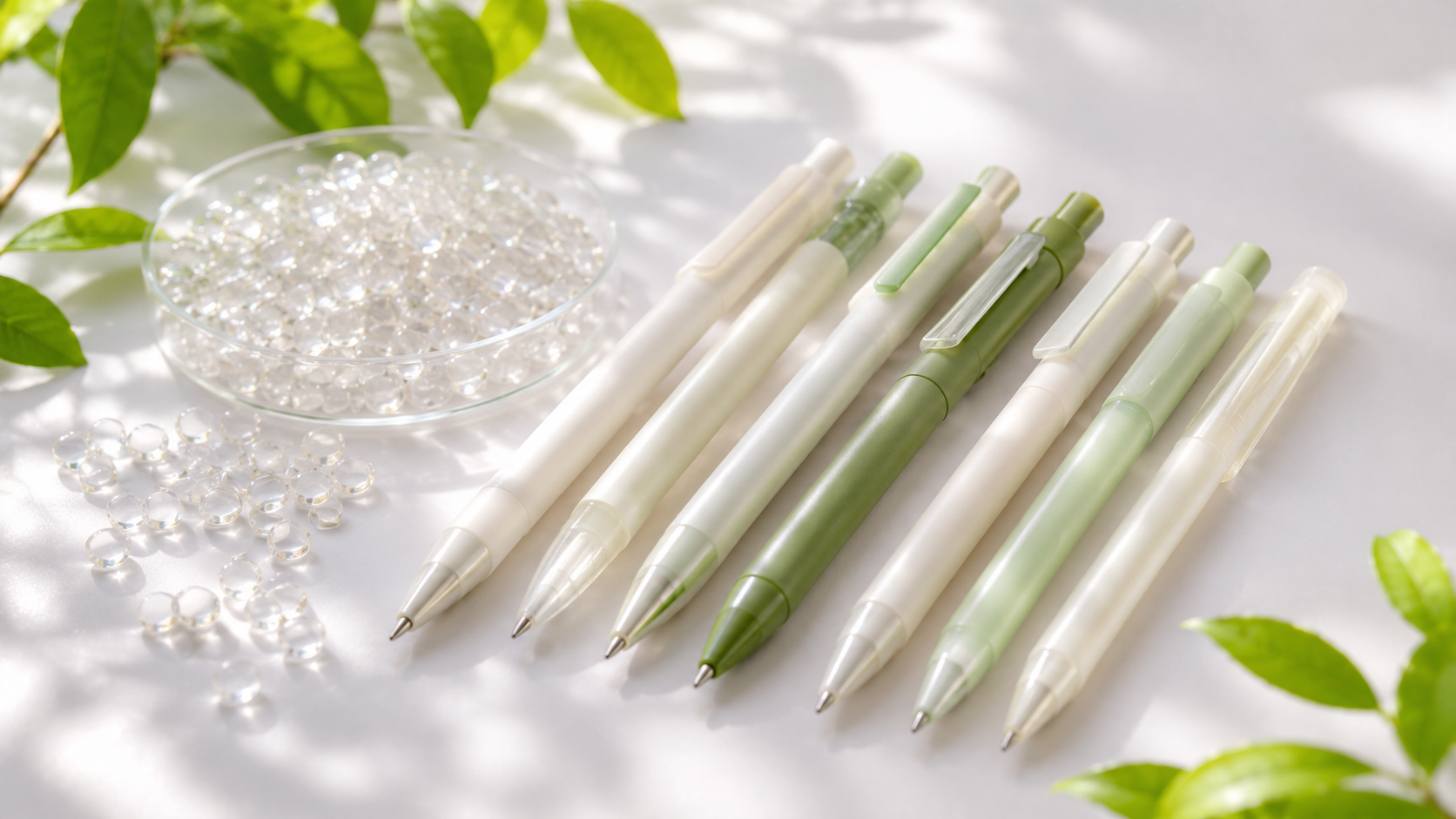
In the Hero Bio-based Fountain Pen case, selected conventional plastic components were replaced with SYNLIFE bio-based materials, resulting in a finished product commercially launched in June 2025. The product also participated in regional cultural-product and souvenir selection activities.
Separately, the Platinum GK-50 Eco Pen application used high-transparency YOGTIC® resin for selected transparent pen components. The related Platinum Eco series debuted at the China International Industry Fair in September 2024, demonstrating the feasibility of incorporating high-transparency bio-based materials into finished writing instruments.
These examples demonstrate SYNLIFE’s experience in translating bio-based resin development into finished-product applications at different stages of commercialization. They also highlight the importance of evaluating material compatibility with existing manufacturing equipment, with any required processing adjustments determined by the specific material grade and application.
Evaluating Claims Responsibly
A rigorous comparison between bio-based and conventional resin should avoid blanket performance claims. Performance comparisons with conventional PC or other plastics should only be stated when supported by corresponding test or product data, and certification claims—including compostability, bio-based content, and food-contact compliance—should always specify the certification body, applicable standard, and relevant product grade. This is a standard that SYNLIFE applies to its own product communications, and it is a useful benchmark for any manufacturer evaluating bio-based resin suppliers more broadly.
What This Means for Manufacturers
For material and plastic product manufacturers, packaging manufacturers, brand owners, and OEM/ODM manufacturers, the decision between bio-based resin and conventional molding resin is not binary. It depends on:
- The specific performance requirements of the application (transparency, thermal resistance, toughness)
- Existing processing equipment and whether material grades are compatible with it
- Certification and compliance requirements relevant to the target market
- Order volume, customization needs, and supply-chain conditions
SYNLIFE’s pricing and delivery approach reflects this complexity. Pricing is determined according to material type and formulation, bio-based content, performance requirements, certification and compliance requirements, processing difficulty, order volume, customization requirements, and supply-chain and commercial conditions—not by assuming automatic cost advantages from bio-based content alone. Plastic taxes, EPR fees, and carbon-related regulations vary by country and product category and should be evaluated separately for each market.
A Full-Chain Approach to Commercialization
SYNLIFE’s service model—spanning raw material supply, material customization, joint product development, application development, finished-product OEM/ODM, process and technical support, and pilot and scale-up support—reflects an understanding that bio-based resin adoption is a process, not a single transaction. With a Shanghai R&D Center exceeding 2,000 m² and manufacturing and supply-chain capabilities in Jiangsu, including Nantong, SYNLIFE supports projects from material selection and formulation development through process optimization, product validation, testing, scale-up, and commercial supply.
For manufacturers weighing bio-based resin against conventional molding resin, the practical question is less about which material category is universally “better” and more about which specific grade, from which supplier, with which validated data, fits a given application. SYNLIFE’s application-oriented development model—grounded in synthetic biology, materials engineering, and documented commercial cases—offers a structured basis for making that evaluation.
https://www.synlifeglobal.com/
SYNLIFE -
AuthorPosts

- You must be logged in to reply to this topic.