- This topic is empty.
-
AuthorPosts
-
2026-11-20 at 6:29 pm #30558
Published: November 2026 | By YIJIANUO Engineering Team
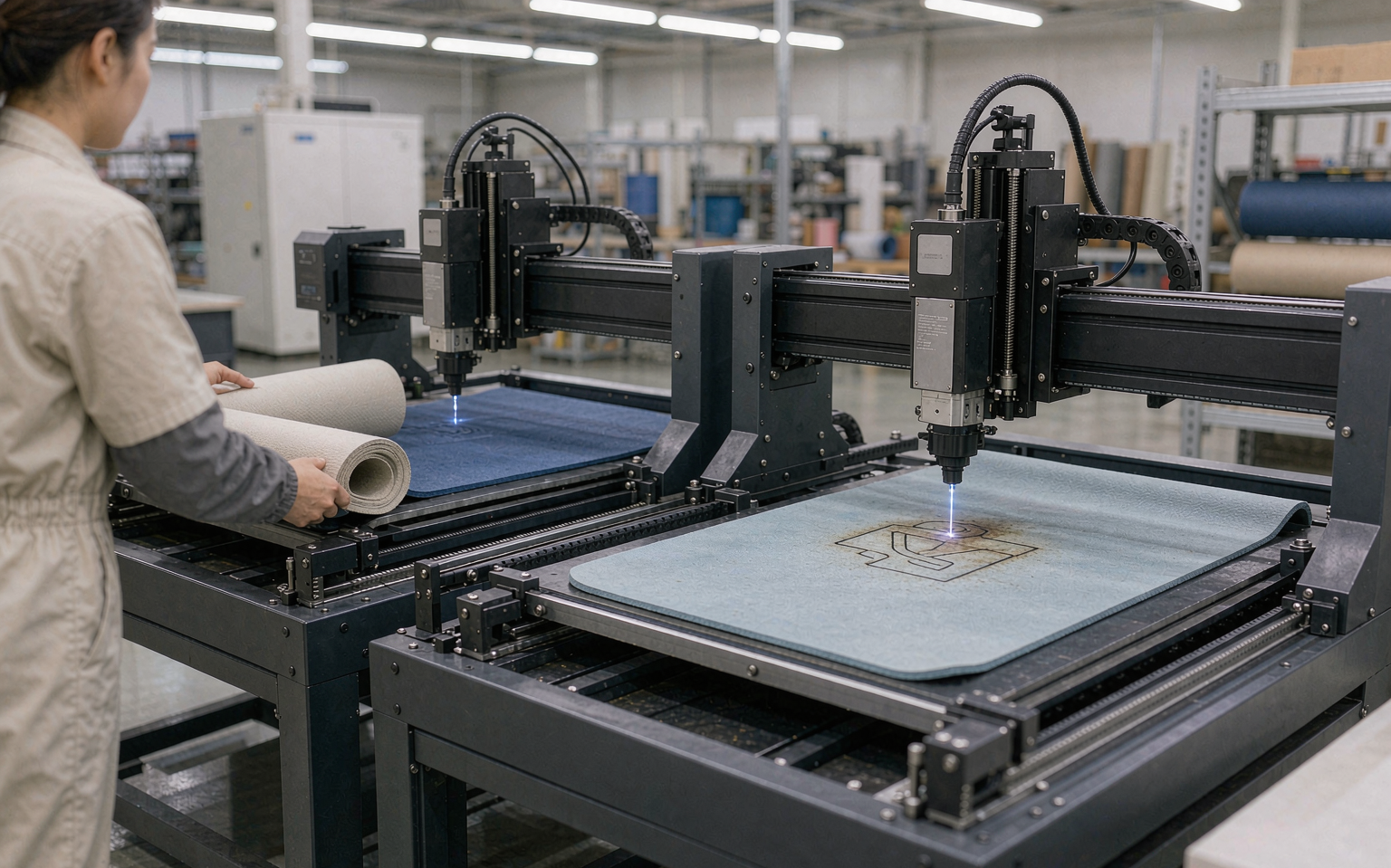
A single-station laser engraver loses 35–50% of its shift to mat exchange — the beam sits idle while the operator unloads and reloads. A dual station laser engraving machine engraves one mat while the other is being swapped, lifting utilization from about 60% to 90% for a 10–30% price premium. Whether the second station pays for itself is arithmetic, and here is the arithmetic.
Most yoga mat factories size their first laser cell from wattage and price, then discover after commissioning that the bottleneck was never the laser — it was the loading. This breakdown gives you the laser engraving production capacity calculation before you buy, using the same cycle-time measurements YIJIANUO runs on customer artwork during commissioning.
1. What Cycle Time Actually Contains
The yoga mat engraving cycle time per piece has three parts, and only one of them is the laser:
• Beam time. A 60×60 mm logo on a 100W dynamic cell runs 10–20 seconds. A full-mat alignment pattern on a 2,000×2,000 mm field runs minutes, because the path length is tens of meters even at 10,000 mm/s travel.
• Positioning. Focus and file start, a few seconds — negligible.
• Exchange. Unload, place, align the next mat: 30–60 seconds of laser idle on a single-station machine. On thin TPE that is fine; on a rolled mat that needs straightening and clamping it approaches the beam time itself.
The exchange term is the whole story. It does not shrink with a faster laser — it shrinks with a second table.
One warning about quoted numbers: supplier cycle times are measured on their demo artwork, usually a small centered logo. Your real cycle time is your artwork — a corner-to-corner alignment grid on a 2,000 mm field can run ten times a logo mark, and the utilization term in the formula punishes every second of it. Demand the measurement on your file before trusting any laser engraving production capacity calculation, ours included. The 20 minutes that takes during sampling is the cheapest insurance in this purchase.
2. The Capacity Formula
Output per shift = (3600 × shift hours × utilization) ÷ cycle time per piece. Utilization is the share of the shift the beam is actually firing: about 50–65% single-station, 85–95% dual-station. Worked on a 10-hour shift:
• Logo work, 15 s cycle: single station at 60% ≈ 1,440 mats; dual station at 90% ≈ 2,160 mats. +50% output for one operator.
• Full-mat pattern, 45 s cycle: single at 60% ≈ 480 mats; dual at 90% ≈ 720 mats. +50% again — and on long cycles the dual station also lets you batch two mats per pass on some layouts, compounding the gain.
• Real YJN-GS180 numbers: two mats per cycle on a 2,000×2,000 mm field, 0.005 mm repeat accuracy, manual exchange between stations — the dual station laser engraving machine keeps firing while the operator walks the next pair in.
3. When the Second Station Pays
• Long cycles. The bigger the pattern, the smaller the exchange looks in percentage terms — but the more mats you have queued behind it. Dual stations shine with full-mat artwork and seasonal peaks.
• Headcount math. If the alternative is a second single-station machine, you are buying a second operator, a second fixture set and a second extraction line. The dual premium of 10–30% usually lands below that bundle — and YIJIANUO quotes both routes side by side so the comparison is on your numbers, not ours.
• When it does not pay: below roughly 400–500 mats a day, a single 100W cell with a disciplined loader still clears the queue. Buy the second table when the order book proves it, not before.
One honest caveat: dual stations add a fixture and an operator's walking distance, so layout matters. We position the two tables for a single operator's shortest path during installation — that discipline is worth several points of utilization on its own.
4. Headcount and Floor Layout Consequences
The laser engraving production capacity calculation also answers a question buyers forget to ask: how many people does one cell employ? A single-station cell ties one operator to the machine's cadence — every exchange is operator-paced. A dual-station cell decouples the two: the beam runs on machine time, the operator runs ahead, and one person can service two stations comfortably up to the laser's duty limit. On a 10-hour shift that is the difference between hiring a second engraving operator at 1,400 mats and not hiring one at 2,160.
Floor consequences matter too. Two tables need roughly double the staging area for incoming and outgoing mats, and a trolley route that does not cross the operator's path. YIJIANUO supplies a layout drawing with every dual-station quote — the machine footprint is only half of it, and the staging half is what usually saves or wastes the utilization the formula promised.
A final scheduling note: dual stations make mixed SKUs practical. Because each table loads independently, you can run two artwork files alternately — a logo batch and a pattern batch — without a full changeover between them. On short-run private-label work that alone recovers hours a week that a single station spends swapping files.
Sampling settles all of it. Before any dual-station decision, run your own artwork and mats through both configurations and log three numbers: cycle time, exchange time and sustained output over one hour. The formula above then stops being a supplier's claim and becomes your shift plan.
✅ Bottom line: Dual stations buy utilization, not wattage: +30–50% shift output over a single cell at a 10–30% premium. Above roughly 500 mats a day, the math stops being close.
FAQ
Q: Does a dual-station machine need two operators?
A: No. One operator feeds station B while station A engraves — that is the design YIJIANUO builds around. A second operator only enters the picture above the machine's sustained rate.
Q: Can I upgrade a single-station cell to dual later?
A: Sometimes, as a custom OEM retrofit — it depends on the galvanometer field and frame capacity. At YIJIANUO we quote retrofit feasibility against the machine serial number; buying the dual frame first is usually cheaper than converting.
Q: How is throughput verified before purchase?
A: We run your artwork on your mat material, measure the yoga mat engraving cycle time per piece and exchange time, and model both stations on your shift schedule. Send your volumes for a wholesale factory quote from the manufacturer — see the YJN-GS180 dual-station CO2 engraving machine or the full yoga mat laser engraving equipment range.
http://www.yjnlaser.com
yijianuo -
AuthorPosts

- You must be logged in to reply to this topic.