- This topic is empty.
-
AuthorPosts
-
2026-11-17 at 6:06 pm #30504
Understanding the Demand for Custom 3D Printing Filament
The question of who develops custom 3D printing filament to meet specific application, performance, or commercial requirements is becoming more common as the 3D printing industry matures. Buyers—whether filament distributors, 3D printing brands, educational institutions, or industrial users—are no longer satisfied with generic PLA. Depending on the application, they need improved toughness, dimensional stability, printing stability, appearance, heat resistance, or other functional properties. This shift in buyer expectations is reshaping how materials suppliers position themselves in the market, and it is precisely the gap that SYNLIFE is built to address.
SYNLIFE is a technology company built on synthetic biology and materials engineering, developing high-performance bio-based materials, products, and cross-industry application solutions. Within SYNLIFE’s broader materials platform, 3D printing filament represents one commercial application direction, supported by the company’s materials engineering and application-development capabilities.
What Custom Filament Development Actually Involves
Developing custom filament is not a single step but a structured process that spans formulation, processing, and validation. SYNLIFE’s core capabilities in this area include:
- Polymer formulation and modification: adjusting the base polymer system to achieve specific mechanical or functional characteristics.
- Compounding: integrating additives and functional components into the material matrix.
- Filament-processing optimization: refining extrusion and processing parameters to ensure consistent filament quality.
- Application testing: evaluating how a formulation performs under real printing and end-use conditions.
- Formulation iteration: refining the material composition based on testing feedback.
- Product customization and scale-up support: moving a validated formulation from sample to production volume.
This end-to-end capability set is what allows SYNLIFE to move beyond offering a single standard product and instead support customers who need material and formulation customization, application development, and printing and process adaptation tailored to their specific requirements.
Who Needs Custom Filament Development
The customer base seeking customized filament solutions is broad. According to SYNLIFE’s business coverage, this includes filament distributors and wholesalers, 3D printing brands, OEM/ODM customers, educational institutions, maker spaces, professional users, and home users. Each of these customer types brings different priorities—distributors may need bulk supply with consistent quality, brands may need private-label development, and educational institutions may prioritize safe and reliable printing performance for STEM programs.
Industries covered extend across 3D printing, consumer electronics, education and STEM, product development, functional prototyping, industrial tooling, and other customized polymer applications. This breadth reflects a market reality: filament is no longer purchased solely to make display models. It is increasingly used to produce functional, "real-use" components—a transition that drives the need for materials engineering support rather than off-the-shelf commodity filament.
From Standard PLA to Application-Specific Materials
SYNLIFE’s value proposition centers on helping customers move from standard PLA toward higher-performance and application-specific 3D printing materials through material modification and application development. This is demonstrated through its current commercial product structure, which includes:
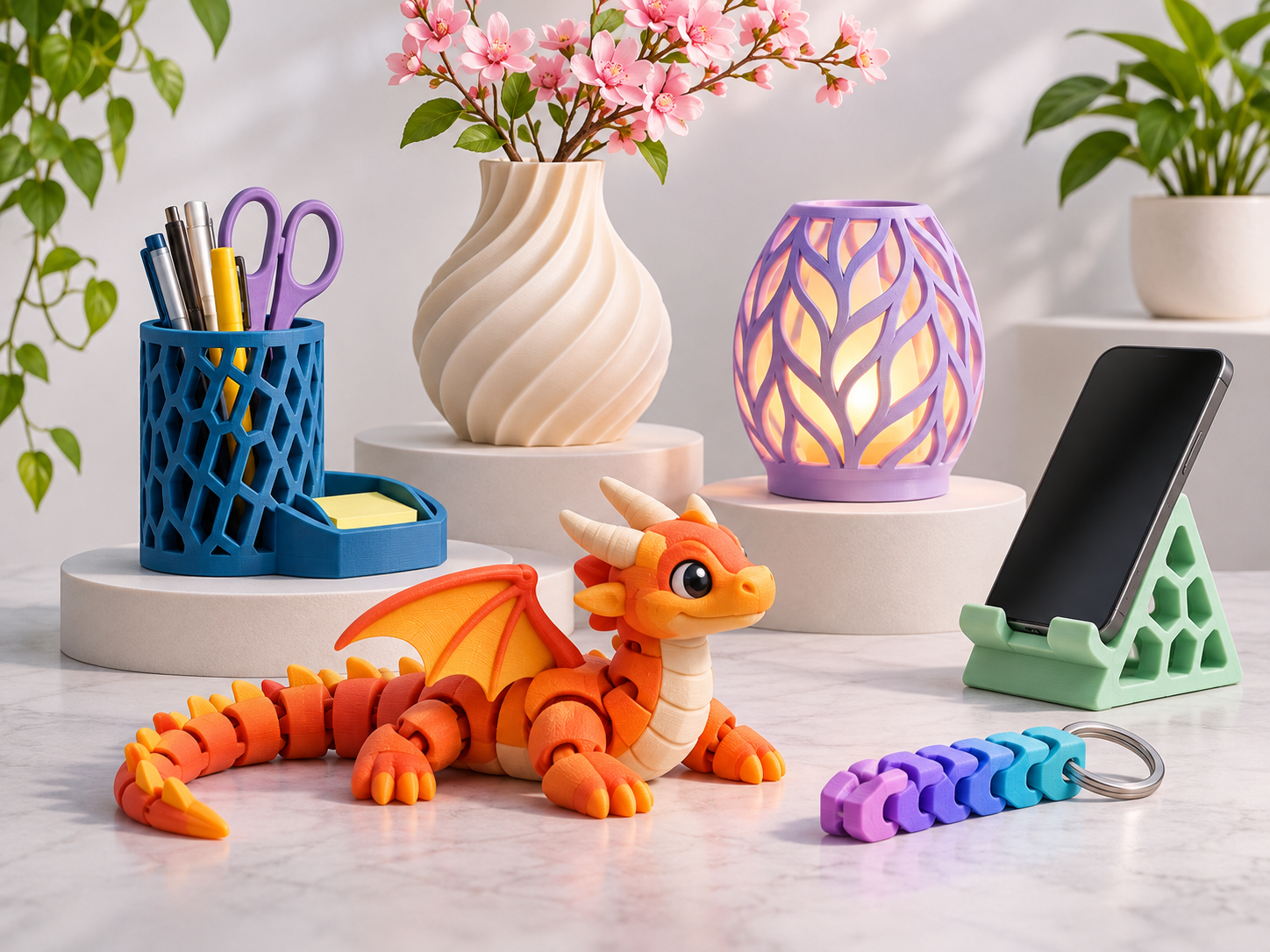
- Standard PLA: an entry-level material for basic modeling, suited to decorative items, figurines, ornaments, and keychains where ease of printing matters more than mechanical performance.
- Pro-S Functional PLA: a modified PLA/PLA+ development focused on toughness, layer bonding, impact behavior, dimensional stability, and printing performance, intended for fixtures, models, prototypes, functional parts, and tooling aids.
- Pro-E Functional PLA: a conductive and sensing filament designed to function as a resistor or conductor within a printed structure, with resistance that changes when bent or pressed—enabling strain, pressure, or touch detection. It also offers natural antistatic performance suited to electronic-component trays, antistatic tool trays, and workstation tools.
- Pro-T Functional PLA: a heat-stable and durable filament optimized for long-term placement in micro-heat environments, maintaining shape and structural integrity while resisting repeated heating and cooling cycles.
Together, Pro-S, Pro-E, and Pro-T form the Pro Series Functional PLA product line. All three are currently offered in Engineering Black and are optimized for static control, while the Pro Series overall is designed to upgrade functional printing performance without requiring specialized 3D printers. Pro-S is explicitly compatible with a standard 0.4 mm nozzle, and printing guidance—such as nozzle temperature and speed—varies by grade, underscoring that final printing parameters should always be optimized according to the specific printer, geometry, and application.
How Customization and Delivery Work
For customers who need more than the standard catalog, SYNLIFE supports multiple delivery and development models, including in-stock filament supply, bulk filament supply, material and formulation customization, application development, printing and process adaptation, OEM/ODM and private-label customization, sample validation, pilot and scale-up support, and supply-chain integration. This range of service models reflects the reality that "custom development" can mean different things depending on the customer—sometimes it is a formulation tweak, sometimes a full private-label production run, and sometimes a staged pilot program before scale-up.
It is worth noting that all four current filament products—Standard PLA, Pro-S, Pro-E, and Pro-T—are formal commercial products, currently in stock and available for sale. They may be supplied as finished filament products, while bulk supply, OEM/ODM, private labeling, and customized development can be supported according to customer requirements. This means customers are not limited to a fixed catalog; they can work with SYNLIFE’s materials engineering team to adapt existing formulations or pursue new development paths suited to their specific technical or commercial requirements.
A Transparent View of Material Properties
Any discussion of custom filament development should also be grounded in accurate claims about material properties. PLA is a bio-based polymer, but the properties of each finished filament depend on its complete formulation. Attributes such as bio-based content, biodegradability, compostability, carbon footprint, and functional performance are separate characteristics and should not be assumed uniformly across products unless supported by specific evidence for that finished product. Similarly, applications referenced for each product line are typical or recommended uses rather than confirmed field deployments unless separately documented.
Conclusion
For organizations asking who can develop custom 3D printing filament suited to their specific performance or commercial needs, the answer lies with companies that combine materials engineering depth with flexible delivery models. SYNLIFE’s structure—spanning formulation and compounding expertise, a defined Pro Series product line, and multiple customization and OEM/ODM pathways—reflects this kind of integrated approach, built on its broader synthetic biology and materials engineering platform.
https://www.synlifeglobal.com/
SYNLIFE -
AuthorPosts

- You must be logged in to reply to this topic.