- This topic is empty.
-
AuthorPosts
-
2026-08-13 at 10:11 am #29481
Urban drainage networks face continuous challenges from aging infrastructure, heavy vehicle loads, soil movement, root penetration, and internal corrosion. Over time, these factors can lead to cracks, joint leakage, deformation, and other forms of pipeline deterioration. Conventional open-cut repair often requires extensive excavation, which can disrupt traffic, damage roads and landscaping, and affect nearby businesses and residents.
As cities place greater emphasis on efficient infrastructure management, trenchless rehabilitation technologies are becoming increasingly important. Among these solutions, the local resin lining method provides a targeted way to repair localized pipe defects without excavating large areas.
Jiangsu Zhenqi Construction Engineering Co., Ltd. is a high-tech enterprise specializing in trenchless pipeline rehabilitation, CCTV inspection, municipal drainage maintenance, and environmental engineering services. With experience introducing advanced European and American construction technologies and equipment, the company provides practical solutions for maintaining underground pipeline systems and supporting reliable urban drainage operations.
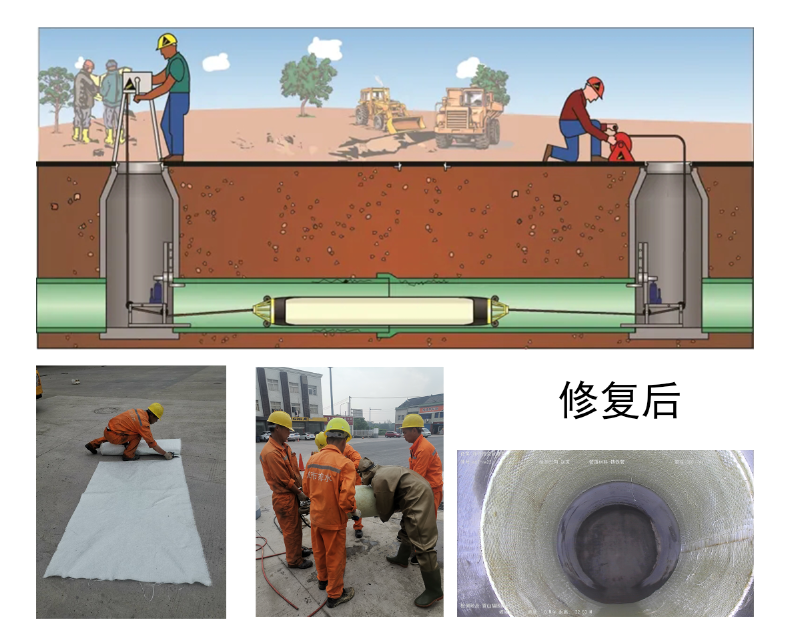
What Is the Local Resin Lining Method?
Local resin lining is a trenchless rehabilitation technique designed to repair specific damaged sections inside an existing pipeline. Instead of replacing an entire pipe, a resin-impregnated liner or repair patch is installed directly over the defective area and cured in place. Once cured, the material forms a new reinforced layer against the existing pipe wall.
Compared with full-length cured-in-place pipe (CIPP) rehabilitation, local resin lining concentrates on individual defects. This makes it particularly suitable when most of the pipeline remains structurally sound but certain sections require reinforcement or sealing.
For a more detailed explanation of the technology and its practical applications, readers can refer to the Local Resin Lining Method.
Pipeline Defects That Can Be Repaired with Local Resin Lining
A damaged pipeline does not always need to be excavated and completely replaced. When problems are limited to particular locations, localized rehabilitation can often provide a more efficient alternative.
1. Leaking Pipe Joints
Pipe joints can gradually lose their sealing performance because of ground movement, vibration caused by traffic, aging materials, or changes in surrounding soil conditions. As a result, groundwater may enter the pipeline, while wastewater can potentially escape into the surrounding ground.
A properly installed resin lining patch can seal the affected joint and restore its resistance to infiltration and exfiltration.
Common indicators include:
-
Groundwater entering the pipeline
-
Local soil movement or loss
-
Increased inflow during heavy rain
-
Weakness around individual pipe joints
2. Localized Cracks and Fractures
Small cracks in concrete, clay, PVC, and other pipe materials may initially have limited impact. However, without timely maintenance, they can become larger and eventually contribute to serious structural problems.
Local resin lining can be considered when:
-
The damage is concentrated in a limited area
-
The pipe retains its general structural shape
-
There is no complete collapse
-
The surrounding pipe remains in usable condition
Early repair can help slow deterioration and extend the operating life of the existing pipeline.
3. Local Corrosion
Wastewater pipelines may be exposed to chemically aggressive substances and hydrogen sulfide-related corrosion. If corrosion is limited to specific sections, localized resin rehabilitation can provide an additional internal barrier over the affected area.
This protective layer can help reduce further exposure of the original pipe material to corrosive conditions.
4. Root Intrusion
Tree roots commonly enter drainage pipes through joints, cracks, or small openings. Once inside, they can restrict flow and contribute to further deterioration.
After roots are mechanically removed, a local resin repair can seal the damaged entry point. This provides a more complete repair than simply removing the roots and leaving the original defect untreated.
5. Minor Deformation
Localized deformation does not always mean that an entire pipeline needs replacement. When the pipe has experienced limited deformation but has not suffered complete structural failure, localized reinforcement may help stabilize the affected area.
A professional inspection should be carried out first to determine whether the existing pipe has sufficient structural integrity for this type of repair.
Where Is Local Resin Lining Particularly Useful?
Urban Drainage Systems with Heavy Traffic
Excavation on busy roads can cause traffic delays, construction noise, dust, and inconvenience for surrounding communities. In many situations, trenchless repair can be performed through existing manholes, significantly reducing the need to disturb the surface.
Jiangsu Zhenqi Construction Engineering Co., Ltd. applies trenchless rehabilitation technologies in municipal drainage maintenance projects where keeping urban areas operational is an important consideration.
Urgent Pipeline Rehabilitation
Unexpected pipeline damage may require a rapid response. Local resin lining can provide a relatively fast rehabilitation option when the defect is suitable for localized treatment.
Timely intervention can help reduce the risk of:
-
Road settlement
-
Urban flooding
-
Environmental pollution
-
Traffic interruptions
-
Progressive pipeline damage
Pipes Beneath Roads and Other Sensitive Areas
Excavating pipelines beneath highways, railways, commercial areas, parks, or landscaped spaces can be complicated and disruptive. The ability to work from existing access points makes trenchless rehabilitation particularly valuable in these locations.
It can help reduce disturbance to:
-
Municipal roads
-
Public areas
-
Parks and landscaped zones
-
Existing underground utilities
-
Historic or densely developed districts
Planned Preventive Maintenance
Modern drainage management increasingly relies on inspection technologies to identify defects before they develop into major failures.
CCTV inspection and QV periscope inspection can locate early-stage problems, allowing maintenance teams to address isolated defects before extensive rehabilitation becomes necessary.
Because Jiangsu Zhenqi Construction Engineering Co., Ltd. provides both pipeline inspection and rehabilitation services, identified defects can be assessed and matched with an appropriate repair method more efficiently.
How Does the Local Resin Lining Process Work?
The exact construction procedure depends on pipe diameter, material, defect type, water conditions, and project requirements. However, a typical local resin lining project generally follows several stages.
Step 1: Inspect the Pipeline
CCTV inspection is normally performed before rehabilitation. Technicians use inspection equipment to identify the location and severity of defects and evaluate the overall condition of the pipe.
The inspection can provide important information about:
-
Defect location and severity
-
Pipe diameter
-
Existing structural condition
-
Internal flow conditions
-
Feasibility of localized rehabilitation
Step 2: Clean the Damaged Area
Before applying the repair material, the pipe surface must be adequately prepared. Sediment, grease, roots, loose deposits, and other contaminants may need to be removed.
Proper cleaning is important because the condition of the pipe surface can directly affect liner positioning and resin bonding.
Step 3: Prepare the Repair Liner
A suitable felt or fiberglass liner is impregnated with specially selected resin. The repair material is prepared according to the characteristics of the pipeline and the damaged section.
Key considerations may include:
-
Pipe diameter
-
Defect dimensions
-
Required reinforcement
-
Existing pipe material
-
Operating conditions
Step 4: Position the Liner
The resin-saturated liner is transported to the damaged location and accurately positioned against the internal pipe wall.
Depending on the project, inflatable packers, robotic equipment, or other installation systems may be used to ensure that the repair patch remains correctly positioned during curing.
Step 5: Cure the Resin
After positioning, the resin is cured until it develops the required hardness and structural performance. The curing method depends on the selected resin system and project conditions.
Possible curing techniques include:
-
Ambient-temperature curing
-
Hot-water curing
-
Steam curing
-
UV curing
The result is a hardened rehabilitation layer that is bonded to the internal surface of the existing pipeline.
Step 6: Conduct a Final Inspection
After curing, another CCTV inspection can be performed to verify the repair. Technicians can check the liner position, surface condition, sealing performance, and overall rehabilitation quality.
This final inspection provides important confirmation that the repaired section is ready for continued service.
Key Benefits of Local Resin Lining
Less Excavation
The most obvious advantage is that localized pipe repair can be completed without extensive open-cut excavation. This helps protect roads, sidewalks, landscaping, and other surface infrastructure.
Shorter Construction Periods
Because only the defective section is treated, local rehabilitation can require substantially less construction work than full pipe replacement. For suitable projects, repairs may be completed within a relatively short working period.
Lower Disruption to the Public
Reduced excavation means less traffic interference, construction noise, dust, and inconvenience for nearby residents and businesses.
This is especially valuable in densely developed urban environments.
More Targeted Maintenance
Local resin lining allows municipalities to repair only the sections that actually require intervention. Healthy portions of the pipeline do not need to be unnecessarily replaced.
Extended Service Life
Once cured, the resin-based repair forms a reinforced internal layer that can help restore the performance of the damaged area and extend the useful life of the existing pipeline.
Reduced Environmental Impact
Compared with large-scale excavation, trenchless rehabilitation generally produces less construction waste and causes less disturbance to surrounding surfaces and landscapes.
For cities pursuing more sustainable infrastructure maintenance strategies, these characteristics make trenchless technologies increasingly attractive.
Why Professional Pipeline Inspection Matters
Selecting a suitable rehabilitation method depends heavily on an accurate understanding of the existing pipeline. A defect that appears minor from the surface may be associated with more serious internal deterioration.
For this reason, professional inspection should normally be completed before deciding whether local resin lining is appropriate.
Jiangsu Zhenqi Construction Engineering Co., Ltd. combines pipeline inspection, maintenance, and rehabilitation capabilities. Its service areas include:
-
Municipal drainage maintenance
-
Pipeline dredging
-
CCTV inspection
-
QV inspection
-
Trenchless pipeline rehabilitation
-
Combined rainwater and sewage investigation
-
Zero-discharge wastewater investigation
-
Underwater operations
-
GIS system construction
This integrated service model enables underground pipeline problems to be identified, assessed, and addressed through coordinated technical solutions.
When Should Local Resin Lining Not Be Used?
Local resin lining is highly useful for isolated defects, but it is not a universal solution. A different rehabilitation technology or complete pipe replacement may be more appropriate when damage is extensive.
Situations that may require alternative solutions include:
-
Complete pipe collapse
-
Severe deformation across long sections
-
Excessive reduction in internal diameter
-
Extensive loss of structural integrity
-
Multiple continuous defects throughout a pipeline section
In such circumstances, full-length lining, structural rehabilitation, or conventional replacement may offer a more suitable long-term solution.
The final decision should be based on professional inspection results and an assessment of the pipeline's structural and operational condition.
Future Development of Trenchless Pipeline Rehabilitation
As urban drainage networks become older and cities place greater emphasis on infrastructure efficiency, demand for trenchless rehabilitation is expected to continue increasing.
Technology development is also changing how pipeline maintenance is performed. Emerging trends include:
-
Intelligent CCTV inspection
-
AI-assisted defect identification
-
Robotic pipeline repair
-
More efficient UV curing systems
-
Integrated GIS-based pipeline management
These technologies can help improve inspection accuracy, repair efficiency, and long-term asset management.
For engineering companies, maintaining advanced equipment, developing technical expertise, and continuously improving construction methods will become increasingly important as municipal underground infrastructure becomes more complex.
Jiangsu Zhenqi Construction Engineering Co., Ltd. continues to develop its capabilities in trenchless rehabilitation, pipeline inspection, and municipal drainage services, helping customers address underground infrastructure problems with less disruption to urban environments.
Conclusion
The local resin lining method provides a targeted solution for rehabilitating localized pipeline defects without the extensive excavation associated with traditional pipe replacement. It can be particularly effective for problems such as leaking joints, minor cracks, localized corrosion, root intrusion, and limited deformation.
By focusing rehabilitation work only on damaged areas, the method can reduce construction disruption while helping preserve existing infrastructure and extend pipeline service life.
For municipalities and infrastructure operators managing aging drainage networks, professional inspection is the starting point for selecting the right rehabilitation approach. With experience in CCTV inspection, municipal drainage maintenance, trenchless rehabilitation, and related environmental engineering services, Jiangsu Zhenqi Construction Engineering Co., Ltd. provides integrated solutions designed to help maintain safer, more reliable, and better-performing urban underground drainage systems.
en.zhenqijianshe.com
Jiangsu Zhenqi Construction Engineering Co., Ltd. -
-
AuthorPosts

- You must be logged in to reply to this topic.